The Concept Of Circumnutation Was First Introduced By Charles Darwin In His 1880 Book, “The Power Of Movement In Plants.” Darwin Observed That Plant Stems And Leaves Exhibit A Slow, Circular Or Elliptical Motion, Even In The Absence Of External Stimuli.
Table of Contents
Darwin termed this phenomenon “circumnutation” and I explain it in more detail below.
Darwin’s meticulous observations and experiments led him to conclude that circumnutation is a fundamental plant movement, essential for growth and development. He suggested that it might help plants to explore their surroundings, find support structures, and optimise their exposure to sunlight.
What Is Circumnutation in Plants?
Circumnutation is a helical organ movement widespread among plants. It is variable due to a different magnitude of trajectory (amplitude) outlined by the organ tip, duration of one cycle (period), circular, elliptical, pendulum-like or irregular shape and clock- and counterclockwise direction of rotation.
Modern Understanding of Circumnutation
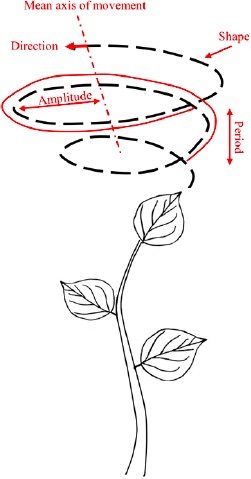
Recent scientific research has expanded our understanding of circumnutation. While Darwin’s initial observations were groundbreaking, modern studies have revealed the complex mechanisms underlying this phenomenon. It builds on the nutation process and describes that form of nutation in plants which is elliptical or round. Moving forward I may well use both terms interchangeably, due to their similarity and the fact the basic concepts overlap.
- Hormonal Control: Auxin, a plant hormone, plays a crucial role in regulating nutation. The uneven distribution of auxin within plant cells triggers differential growth, causing the plant to randomly bend and twist.
- Circadian Rhythms: Circumnutation is often influenced by circadian rhythms, the internal biological clocks that regulate various plant processes. These rhythms can affect the timing and intensity of circumnutation movements.
- Environmental Factors: Light, temperature, and gravity can also influence nutation. For example, plants may adjust their circumnutation patterns in response to changes in light intensity or the direction of gravity.
The Importance of Circumnutation
Circumnutation is essential for plant growth and survival. It helps plants to:
- Explore their environment: By moving their stems and leaves, plants can explore their surroundings and find optimal conditions for growth. This explains how plants find every soil crevice to force their roots through.
- Avoid obstacles: Nutation can help plants to avoid obstacles and find support structures, such as trees or fences.
- Maximize photosynthesis: By adjusting their orientation, plants can optimise their exposure to sunlight, maximising photosynthesis.
Recent Research and Applications
In recent years, researchers have continued to investigate the mechanisms and implications of all forms of nutation. This research has led to new insights into plant development, as well as potential applications in agriculture and horticulture.
For example, understanding nutation could help scientists develop crop varieties that are more resistant to environmental stresses, such as drought or strong winds. Additionally, studying circumnutation in climbing plants could provide insights into the design of artificial climbing structures.
My Conclusions
Charles Darwin‘s discovery of circumnutation laid the foundation for our understanding of this fascinating plant movement. Modern research has further explained the mechanisms underlying circumnutation and its importance in plant growth and development. As scientists continue to investigate this phenomenon, we can expect to uncover even more about the remarkable ways in which plants interact with their environment.
Research Sources:
Circumnutation as an autonomous root movement in plants
Circumnutation Tracker: novel software for investigation of circumnutation
Join My Gardening Groups …. Or Buy My Books
Gardening Advice
To join the How to Dig For Victory Facebook group follow the link.
And here is the link to UK Garden Flowers, Trees, Shrubs & More
And Allotment Life For Beginners
You can also find me on Substack StefanDrewe.substack.com
Patreon
Help keep this website free from advertisements by supporting me on Patreon.
Free and subscription options available with informative infographic downloads as a thank you.
Gardening Books
Find your next favourite read without the guesswork.
I have hand-picked the best titles to save you time, or you can browse millions of other books in the full collection.
Prefer to read my own writing? You can purchase my original books directly on Amazon.
#BiteSizedGardening #Gardening #Vegetables #veg #fruitandveg #allotment #biointensive
Tag: Circumnutation
Image Attribution: Isabel Fiorello, Emanuela Del Dottore, Francesca Tramacere, Barbara Mazzolai, CC BY-SA 3.0, via Wikimedia Commons

