The Following Content About Angelica Is From The 1920 Translation of Vilmorin’s The Vegetable Garden (Les Plantes Potagères).
Table of Contents
The French firm of Vilmorin-Andrieux & Cie was founded in 1743 in Paris and grew to become the world’s most prominent seed company and a major force in botanical and agronomic research throughout the 19th century. The Vegetable Garden was a crowning achievement, first released in France between 1850 and 1895 and translated into English in 1920 under the direction of William Robinson. The text’s specific archaic spellings are characteristic of these late 19th-century publications.
Article Synopsis
This article concerns Angelica (Angelica archangelica, L.), a majestic, stout-stemmed herb, often cultivated as a biennial, prized for its pervasive aromatic odour and traditionally revered for its medicinal properties, including its historic epithet, “The Root of the Holy Ghost.”
French, Angelique officinale, A. de Boheme, Archangelique. German, Angelica, Engelwurz. Flemish, Engelkruid. Dzitch, Engelwortel. Italian, Spanish, and Portuguese, Angelica.
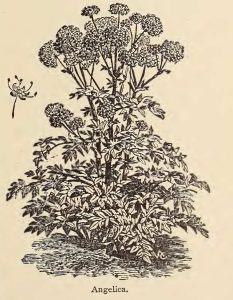
A native of the Alps.—Perennial.—This plant has a very thick, hollow, herbaceous stem, upwards of 4 ft. high ; leaves very large, from I to 3 ft. long, red-violet at the base, long-stalked, and terminating in three principal toothed divisions, which are sub-divided into three similar smaller divisions. Flowers small, numerous, pale yellow, in umbels which unite to form a roundish head. Seed yellow, oblong, flat on one side, convex on the other, with three prominent ribs, and membranous edges. The germinating power of the seed continues for a year, or at most two.
Culture.—Angelica requires a good, rich, slightly humid, and deep soil. The seed is sown in springorsummerin nursery beds, and the plants are planted out permanentlyin autumn,and will commence to yield in the following year (provided they are well grown), when the leaves may be cut. In the third year, at the farthest, the plants run to seed ; in this year, both stems and leaves are cut, and the plantation is destroyed.
Uses.—The stems and leaf-stalks are eaten preserved with sugar. The leaves are also used as a vegetable in some parts of Europe. The root, which is spindle-shaped, is employed in medicine : it is sometimes called ” The Root of the Holy Ghost.” The seeds enter into the composition of various liqueurs.
More From Vilmorin
To discover more about Vilmorin’s work, plants and book type Vilmorin in to this website’s search bar.