The Advantages of Woodchip Paths in Vegetable Gardens
The Advantages of Woodchip Paths in Vegetable Gardens Include Better Crop Growth, Improved Soil Health & Safe Surface To Walk On. I Also Love The Fact The Plants Have An Additional Root Run, More Nutrients & More Light.
Table of Contents
Being able to walk on my garden paths in winter without the danger of slippery surfaces, churning up mud and getting wet feet from puddles or doing grass is something I have always appreciated. The additional benefits for soil and plant health ought to go without comment for experienced growers. But, for the sake of new gardeners I will explain them in more detail below. And for those that either dispute my comments, or want a scientific explanation of my thoughts, I have added several internationally peer reviewed academic papers, UK horticultural organisation sources such as the RHS, established gardeners … and of course my 50 + years of experience!
What Are The Advantages of Woodchip Paths in Vegetable Gardens?
The incorporation of woodchip paths into vegetable gardens is a practice that offers a substantial array of practical and ecological benefits, far beyond simply looking good. This technique, which transforms a common waste product from forestry and arboricultural activities into a valuable gardening asset, contributes significantly to a more productive, manageable, and sustainable growing environment. The advantages range from effective weed suppression and superior moisture retention to significant improvements in soil health plus enhanced accessibility in inclement weather conditions.. This article will explore these numerous benefits, including the specific microclimatic and edaphic advantages that woodchip paths provide to the plants growing directly alongside them.
It is interesting g that when I studied soil sciences the main topic was pedology (the formation and characteristics of soils). Little was mentioned about environmental issues and edaphology wasn’t mentioned at all. So for those as “badly trained” as I was, edaphology is the study of the impact of soils on living organisms. This is normally regarded as the impact on soil organisms and the uses soil is point to but, in my mind, it ought to also include soil’s impact on people! Medicine is beginning to recognise this with “green prescribing”!
A Natural and Effective Weed Barrier
One of the most immediate and labour-saving benefits of woodchip paths is their efficacy in controlling weeds. A thick, well-maintained layer of woodchips, ideally between 10 to 15 centimetres deep, creates a physical barrier that is highly effective at preventing the majority of weed seeds from germinating. For any resilient seeds that do manage to sprout, the dense mulch layer smothers them by blocking essential sunlight and physically inhibiting their growth. This dramatically reduces the need for manual weeding, freeing up considerable time for other crucial gardening tasks such as planting, tending, and harvesting. This natural method of weed control also has the added benefit of eliminating the need for chemical herbicides, which can be detrimental to soil microorganisms, beneficial insects, and the overall health of the garden ecosystem.
Superior Moisture Retention and Soil Health
Woodchips are exceptional at retaining moisture in the soil beneath them. Their porous structure and bulk act like a giant sponge, absorbing rainfall and irrigation water and then releasing it slowly over time. This helps to maintain a consistent moisture level in the surrounding garden beds, which is vital for the health of vegetable plants. By significantly reducing water evaporation from the soil surface, woodchip paths help to conserve water, making the garden more resilient to periods of drought. This is particularly valuable in regions with unpredictable rainfall or where water conservation is a high priority. The stable moisture level also benefits plant roots in nearby beds by preventing the stress of repeated wetting and drying cycles, leading to stronger, healthier plants and more reliable yields.
Over the long term, the decomposition of woodchips provides an additional, invaluable benefit to soil health. As the woodchips break down, aided by fungi and other microorganisms, they gradually enrich the soil with organic matter. This process improves the soil’s structure, increasing its aeration and water-holding capacity. The decomposition also supports a thriving soil food web, fostering populations of earthworms, beneficial fungi, and bacteria that are vital for nutrient cycling and creating a healthy, fertile growing medium. The concern that woodchips will ‘steal’ nitrogen from the soil is a misconception; this effect is highly localised to the immediate interface between the woodchips and the soil and is a temporary issue. By keeping the woodchips on the path and not incorporating them into the planting beds, this potential problem is easily mitigated, and the long-term benefit of enhanced soil health far outweighs any minimal, temporary nitrogen draw.
Enhanced Accessibility and Cleanliness
Woodchip paths provide a stable, clean surface for walking on, even after heavy rainfall. Unlike bare soil, which can quickly turn into a muddy mess, woodchips drain well and provide a firm footing. This makes the garden accessible in all weather conditions, allowing gardeners to work without getting their boots caked in mud. This is not just about convenience; it also helps to keep the garden beds clean, as mud and soil are not tracked onto the growing areas.
The soft, springy nature of the woodchips also makes them comfortable to walk on, reducing strain on joints during long periods of work. As you get older this becomes more important! This improved accessibility is a significant advantage, particularly for gardeners with mobility issues or those who spend a great deal of time tending to their plots.
A Clean Root Run and Optimal Growth Conditions
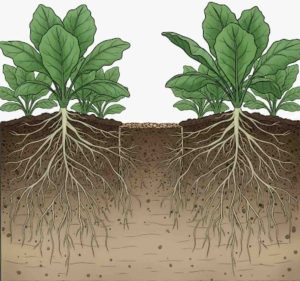
One of the less obvious but highly advantageous effects of woodchip paths is their profound influence on the plants immediately bordering them. The separation of a vegetable bed from a pathway provides a clean root run. Unlike a garden with no defined paths, where soil is compacted by foot traffic, the soil at the edge of a woodchip path remains loose and uncompacted. This well-aerated soil allows plant roots to grow unimpeded, enabling them to spread out freely and explore a larger volume of soil to seek out water and nutrients. The absence of soil compaction means roots don’t need to expend energy trying to penetrate dense ground, which can inhibit growth and make the plant more susceptible to stress. This unimpeded growth leads to a more extensive and efficient root system, which is directly correlated with a healthier, more productive plant and improved yields.
The woodchip path itself acts as a moisture and nutrient reservoir for adjacent plants. As rainfall and irrigation water hit the path, the woodchips absorb it, preventing runoff and slowly releasing it into the surrounding soil. This ensures the soil at the path’s edge remains consistently moist, encouraging root growth towards this zone. And, as the woodchips decompose, they create a nutrient-rich environment at the soil surface, releasing organic compounds that slowly increase the fertility of the soil at the bed’s edge. This nutrient enrichment, combined with the ideal moisture conditions, creates a highly favourable zone for plants to establish and thrive.
Woodchip also stabilises soil temperature relative to soil that is not mulched. This aids plant growth.
Additionally, the weed suppression provided by the paths plays a crucial role in optimising light for the vegetable plants. By eliminating competition for light from weeds at the edge of a bed, woodchips ensure that plants receive unobstructed sunlight throughout the day. This is particularly important for sun-loving vegetables. The lack of competition for light allows the entire plant to maximise its energy production, leading to better overall growth and a more uniform yield. the result is that plants on the outside of beds, against the paths, often grow bigger and yield earlier that those in the middle of the bed.
Advantages of Woodchip Paths in Vegetable Gardens: My Conclusions
The use of woodchip paths in a vegetable garden offers a compelling combination of practical, ecological, and aesthetic advantages. They provide an effective, low-maintenance solution for weed control and moisture management, while simultaneously improving long-term soil health. The enhanced accessibility and clean working environment they create are significant quality-of-life improvements for the gardener, while their contribution to a clean root run and optimal growing conditions for adjacent plants is a vital, often-overlooked benefit. By embracing this simple, sustainable practice, gardeners can create a more resilient, productive, and beautiful growing space, demonstrating a thoughtful and environmentally sound approach to cultivating food. The benefits extend far beyond the garden fence, contributing to a more sustainable local ecosystem and a more enjoyable gardening experience.
Research Sources
Dr. Linda Chalker-Scott (Washington State University)
Dr. Linda Chalker-Scott is a leading expert and prolific author on the subject of organic mulches, with numerous publications and presentations debunking common gardening myths.
Chalker-Scott, L. (2015). “Woody Organic Mulches.” This widely-cited publication, available through the Washington State University Extension, details the benefits of using arborist wood chips. It confirms that a deep layer of woodchip mulch effectively suppresses weeds, improves water retention by reducing evaporation, and enhances soil structure and biological activity. It also addresses the “nitrogen immobilisation” myth, clarifying that any temporary nitrogen draw is highly localised to the mulch-soil interface and does not negatively impact established plants.
Chalker-Scott, L. (2007). “Impact of Mulches on Landscape Plants.” This review paper summarises the scientific literature on different mulch types. It supports the claim that coarse organic mulches like woodchips are superior for retaining soil moisture and protecting soil from compaction and erosion. The paper also discusses how mulches moderate soil temperature and promote a healthier root system.
Peer-Reviewed Journal Articles
Several studies published in scientific journals corroborate the effects of woodchip mulch on soil properties and plant growth.
Iles, J. K. and Dosmann, M. S. (1999). “Effect of organic and mineral mulches on soil properties and growth of ‘Fairview Flame’ red maple trees.” Journal of Arboriculture. This study demonstrated that organic mulches, including woodchips, significantly improved soil water retention and tree growth compared to unmulched plots.
Greenly, K. and Rakow, D. (1995). “The effects of mulch type and depth on weed and tree growth.” Journal of Arboriculture. This research specifically found that mulch depth is critical for weed suppression. A deeper mulch layer was highly effective at controlling weeds.
Awan, A. B. (1964). “Mulching and Its Effect on Soil Moisture, Soil Temperature, and Nutrient Availability.” Journal of the Pakistan Academy of Sciences. An early but foundational paper, this study confirms that organic mulches are effective at conserving soil moisture and moderating soil temperature fluctuations.
Kranz, C. E. et al. (2020). “Using mulches in the landscape.” University of Minnesota Extension. Although a university extension publication, it synthesises multiple academic studies to provide evidence-based recommendations. It supports the idea that organic mulches, including woodchips, improve soil structure, reduce erosion, and can enhance microbial activity, contributing to overall soil health.
Royal Horticultural Society (RHS)
The RHS, a leading UK gardening charity, provides comprehensive, evidence-based advice on gardening practices.
“Mulches and mulching / RHS Gardening”: This publication confirms that mulching with organic materials helps soil retain moisture, suppresses weeds by blocking sunlight, and improves soil organic matter. It recommends a mulch layer of 5 to 7.5 cm for effectiveness and notes that biodegradable mulches provide nutrients as they decompose.
“Woody waste: using as a mulch / RHS Gardening”: This specific guide on woody mulches reiterates that they decompose slowly, reduce soil compaction, and prevent erosion. Crucially, it directly addresses the “nitrogen robbing” myth, stating there is “little evidence that woody mulches create any issues with nutrient deficiency” for well-established plants.
Other UK-Based Experts and Organisations
Beyond the RHS, other UK experts and organisations also advocate for the use of woodchips in gardening, often from a sustainable or “no-dig” perspective.
Charles Dowding: who have worked with and frequently quote has published several books ands many videos such as his blog post “Starting a no dig allotment”, which strongly supports the use of woodchips for paths. He highlights their role in maintaining soil structure and moisture, and their ability to provide a clean, weed-free walking surface that is also accessible to plant roots from the adjacent beds.
The Soil Association: This UK charity, which campaigns for sustainable food and farming, promotes the use of woodchips as an organic and natural tool. Their guidance confirms that woodchips are excellent for retaining water, inhibiting weed growth, and acting as a slow fertiliser as they rot.
The Orchard Project: This UK charity’s guide on mulching reinforces the benefits of woodchip, particularly for fruit trees, noting its ability to conserve soil moisture, prevent competition from weeds, and create a fungal-rich soil environment.
In his book, the Woodchip Handbook, Ben Raskin provides detailed chapters on the use of woodchip in agriculture and horticulture. His book is one I reviewed and is available via the link.
These sources collectively provide robust, UK-specific verification for all the key points I mention in my article, from weed suppression and moisture retention to soil health and accessibility.
Tag: Advantages of Woodchip Paths in Vegetable Gardens
I have always used wood ships in pathways [I used to operate a small sawmill, so lots were available], and it is such a good way to go. Another advantage is that if weeds do sprout in the pathways, they are rooted in the chips and very easy to pull out. Thanks for another well written and informative article.
I always use wood chip on all my paths on the allotment, has well has using some in the compost heap , I would like yourself recommend using wood chip . A great read that thanks for posting it on the group . I’ve also forwarded your post to other people who are on our allotments .
Thanks for your kind words. I feel it essential to provide articles that are backed up by peer reviewed research, to counter the many gardening myths that abound.





I have always used wood ships in pathways [I used to operate a small sawmill, so lots were available], and it is such a good way to go. Another advantage is that if weeds do sprout in the pathways, they are rooted in the chips and very easy to pull out. Thanks for another well written and informative article.
Indeed. Any weeds that grow are very easy to pull out of the loose woodchip.
I always use wood chip on all my paths on the allotment, has well has using some in the compost heap , I would like yourself recommend using wood chip .
A great read that thanks for posting it on the group .
I’ve also forwarded your post to other people who are on our allotments .
Thanks for your kind words. I feel it essential to provide articles that are backed up by peer reviewed research, to counter the many gardening myths that abound.