Knowing How To Sterilise Garden Soil Is Useful When Small Batches Are Needed For Seed Sowing & Potting. It Quickly Destroys Weeds, Pests & Diseases At Minimal Cost.
Table of Contents
For decades commercial growers have sterilised their greenhouse border soil using steam or chemicals. But on a garden or allotment scale these methods aren’t really possible. But we can still sterilise soil by other means and in this article I look at the methods that are viable on a small scale.
These methods are particularly good for small-scale operations like seed starting indoors or in a greenhouse, where the risk of soil-borne pests and diseases is higher than in the garden soil.
Why Sterilise Garden Soil?
The primary reasons a UK gardener might consider sterilising soil are:
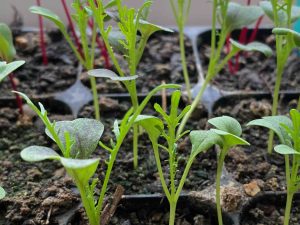
To kill pests and pathogens: It helps to eliminate harmful organisms like fungi, bacteria, and nematodes that can cause diseases such as ‘damping off’ in seedlings.
To eradicate weed seeds: The high temperatures kill off weed seeds, giving young plants a clean start without competition.
For reusing old compost: It can be used to revitalise compost from previous years’ pots or containers, usually before additional nutrients/fertilisers are added.
It’s important to note that sterilisation also kills beneficial soil microbes, so the soil will need to be re-inoculated with fresh compost or manure to restore its microfauna after the sterilisation process.
Soil Sterilisation Methods
Here are a few common methods for sterilising soil, from the most practical for small batches to a method for larger areas.
1. Solarisation (for large gardens and allotments)
This is a chemical-free method that uses the sun’s energy to heat the soil. It is best carried out during the hottest part of the summer. I’m adding it because I know people will ask about larger areas. Beware, this will kill surface weed seeds etc, but it does not penetrate deep. So if you then dig the effect is destroyed. However, for surface killing, it works.
Preparation: Clear the area of weeds and debris. Water the soil thoroughly to ensure soil is damp to a depth of at least 12 inches.
Process: Cover the moist soil with a sheet of clear plastic (polythene), securing the edges with rocks or soil to create an airtight seal.
Timing: Leave the plastic in place for 4 to 6 weeks. The sun’s heat will be trapped beneath the plastic, raising the soil temperature high enough to kill many pests, pathogens, and weed seeds.
NB Solarisation will sterilise the soil surface but the high temperature does not penetrate very deep so don’t expect wonders. It only works “skin deep”!
2. Microwave Sterilisation (for very small batches)
This is a quick and effective method for sterilising a small amount of soil for seed trays or pots. Crucially, this should only be done for a few minutes and with a small quantity of soil to avoid a potential fire risk. The process will also produce a rather beautiful petrichor odour, so ensure the area is well-ventilated if you don’t like it.
Preparation: Use a microwave-safe container and fill it with about 1-2 inches of moist, but not waterlogged, soil. Once you get more experienced you might want to use larger and deeper volumes of soil. I now microwave batches of 3-4 litres at a time.
Process: Place the container in the microwave and heat on a high setting for about 90 seconds to 2 minutes, depending on the volume. The goal is to get the soil hot enough to kill pathogens and seeds. I aim at around 70-80C. If, like me you microwave larger volumes it is easier to microwave in two or three 3-4 minute sessions and allow the heat to penetrate between sessions. The “resting” stage allows steam/heat penetration and ensures the centre gets up to temperature.
Safety: The container and soil will be extremely hot. Use oven gloves to remove it and let it cool completely before use. Do not over-cook, as the organic matter can potentially ignite if heated for too long.
3. Oven Sterilisation (for small batches)
This method is suitable for slightly larger quantities of soil than the microwave method.
Preparation: Place about 3-4 inches of moist, but not waterlogged, soil in an oven-safe container (e.g., a metal roasting tray).
Process: Cover the container with foil and bake in a preheated oven at a low temperature, around 80-90°C (180-200°F), for about 30 minutes. The soil’s internal temperature should reach at least 70-80° to be effective.
Cooling: Allow the soil to cool completely before using it.
4. Steaming (for small to medium batches)
Steaming is a very effective method for sterilising soil and can be done in a kitchen or a shed with a heat source.
Preparation: Place the moist soil in a pot or heat-proof container, no more than 4 inches deep.
Process: Place a steaming rack in the bottom of a larger pot with a few inches of water. Place the container of soil on the rack, cover with a lid, and bring the water to a boil. Allow the soil to steam for at least 30 minutes.
Cooling: Remove from the heat and let the soil cool down completely. A wallpaper steam stripper can also be adapted for larger quantities.
A Note on Best Practices
Sterilising soil is a powerful tool, but it should be used judiciously. For most large areas of a kitchen garden or allotment, a healthier and more sustainable approach is to focus on improving overall soil health. This can be achieved through:
Crop Biointensity: To prevent the build-up of specific pests and diseases.
Adding Organic Matter: Regular applications of well-rotted manure and homemade compost will introduce beneficial microorganisms and build a robust, disease-suppressing soil ecosystem.
No-Dig Gardening: This method promotes a healthy soil structure and fungal network, which naturally reduces weed growth and improves plant resilience.