How to Grow Perennial Leeks: A Low-Maintenance Delight for UK Gardeners
Ease Your Gardening Effort & Costs With Perennial Leeks. A Hungry Gap Veg That Will Regrow For Years. Learn How To Grow Perennial Leeks Now.
Table of Contents
Perennial leeks are an excellent addition to any UK garden, offering a sustainable, low-maintenance alternative to traditional annual leeks. Unlike their biennial cousins, perennial leeks come back year after year, providing a steady harvest with minimal effort. Two popular varieties are Babington leeks (a wild British native most often found in coastal regions) and Poireau Perpetuel (a French heirloom). Both are hardy, resilient, and perfect for gardeners who love a “plant once, harvest forever” approach. perennial leeks are excellent for polyculture growing, food forests or gardeners who find they want to relax rather than work hard in the garden!
A Brief History of Perennial Leeks
Perennial leeks have been cultivated for centuries, prized for their ability to regrow from the same bulb year after year. Babington leeks (Allium ampeloprasum var. babingtonii) are native to the British Isles and were traditionally foraged along coastal areas. Poireau Perpetuel, on the other hand, has been grown in French kitchen gardens for generations. Unlike regular leeks, these varieties reproduce via underground offsets and aerial bulbils (tiny bulb-like structures that form on the flower stalk), ensuring their survival without cross-pollination.
How to Grow Perennial Leeks
Sowing & Planting
Perennial leeks can be grown from bulbils (small bulbs) sown directly or started in pots.
Sowing in pots (Autumn to Spring):
Fill pots with moist compost and sow around 20 bulbils per large pot.
Keep the compost damp but not waterlogged.
Once the leeks sprout and are large enough to handle, transplant them into the garden.
Dib them in deep (like traditional leeks) to encourage long, blanched stems.
Or sow singly in modular cells and transplant as above with a bit of compost around the roots.
Sowing directly (Autumn to Spring):
Plant bulbils 2cm deep in a sunny, well-drained spot.
Mark the area so you don’t forget where they are!
Germination can be erratic—some may sprout in 4-6 weeks, while others take longer.
Perennial Leeks: Growth & Care
First year: Expect small leeks as the plants establish.
Second year: Growth improves, and plants may produce flowers and aerial bulbils.
Dormancy: In summer, the foliage dies back, but the bulb remains alive underground. New growth returns in autumn when moisture levels rise.
Propagation
Perennial leeks multiply in two ways:
Underground offsets – Divide these every few years to spread your crop.
Aerial bulbils – After flowering, the stalk bends over, allowing bulbils to self-sow or be collected and replanted. this is similar to the way Egyptian walking onions propagate.
Harvesting
Best time: Early spring to early summer.
Method: Cut stems at the base, leaving the bulb to regrow. Avoid overharvesting in the first year to allow strong establishment.
Pests & Diseases
Rust can appear later in the season but rarely affects early harvests.
Thrives in polycultures (mixed planting) rather than monocultures.
Cooking & Eating
Perennial leeks have a rich, savoury flavour with a hint of garlic. Use them in:
Soups and stews
Stir-fries
Pies and quiches
Final Thoughts
While perennial leeks take time to establish, they’re a long-term investment that rewards patience. Once settled, they provide delicious, homegrown leeks for years to come—with far less work than annual varieties. Perfect for the busy UK gardener! They are also great for allotments where inspections require a specific amount of cropping. These leeks are always filling the ground! But don’t worry about them taking up too much space. Use the space between the rows when they die back in summer. Ideal crops for this would be lettuce, Asian greens, etc. ie quick catch crops.
How to Grow Perennial Leeks: Image notes
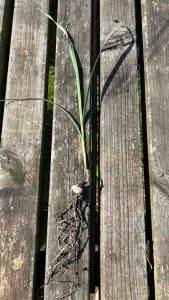
The first image shows the root system of a pot grown plant grown from a bulbil planted in December. The photo was taken in late April. Some grew even bigger roots than this.
Those plants grown in modules had more reduced root length but the above ground plant seemed just as big and vigorous.
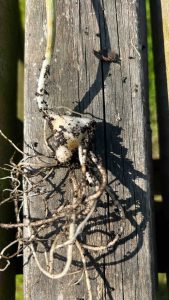
Image two shows the development of bulbils in a plant raised as above. Even at a few months old, before being planted in the garden, new bulbils were growing. Many pants had two additional bulbils and this demonstrates how productive these plants are.