Mini Food Forests Or Guilds Can Become Highly Productive Low Maintenance Linear Food Forests With Very Little Effort. Here’s How.
Table of Contents
Elsewhere I have written about food forest tree guilds. In this article I want to explain how these mini food forests can become liar food forests.
What is a Linear Food Forest?
A linear food forest is a narrow, elongated planting system designed to maximise biodiversity, food production, and ease of access. Unlike traditional food forests—which are often large and circular—linear food forests are arranged in long strips, making them ideal for small gardens, allotments, or hedgerows. Think of them as if they are forest garden beds that are easy to access and control whilst embracing nature.
Inspired by forest edge ecosystems, these gardens combine fruit trees, shrubs, perennials, and ground cover plants in a structured yet natural way. The design allows for easy maintenance (with access from both sides) while mimicking the resilience of wild habitats.
Key Benefits for UK Gardeners
Space-efficient – Fits into narrow urban gardens or along fences. Low-maintenance – Uses self-seeding plants and “chop and drop” fertility. Wildlife-friendly – Supports pollinators and pest predators. Year-round harvests – Includes plants with staggered harvest seasons.
An Extra Benefit of Linear Food Forests
Because they are grown in narrow strips are can be bordered by grass or wood chip paths they are accessible all year. And if the paths are grass they are producing mulch for the beds.
How Linear Food Forests Extend Tree Guilds
A tree guild is a companion planting system where a central tree is surrounded by supportive plants (e.g. nitrogen fixers, mulch producers, pest deterrents). A linear food forest takes this concept further by stretching it into a continuous, interconnected row.
Example of a Linear Food Forest Guild:
Canopy Layer (if space allows): Dwarf apple or plum trees.
Shrub Layer: Currant bushes, hazel, or dwarf raspberries.
Root Layer: Jerusalem artichokes, dandelions (for deep nutrient mining).
This multi-layered approach ensures efficient use of space while improving soil health through natural nutrient cycling.
How to Build a Linear Food Forest (Step-by-Step)
1. Choose the Right Location
Sunlight: At least 6 hours of sun for fruiting plants.
Access: Ensure you can reach both sides (1–1.5m width ideal).
Soil: Improve with compost or woodchip if needed, but many food forest plants tolerate poor soils.
Weed Control: Woodchip and cardboard can be used to control the weeds initially. Eventually this can be superseded with chop and drop and natural processes.
This is just a small selection. There are hundreds of plants that could be used to create a linear food forest. The only limit is nature and your imagination.
Fruit Trees & Shrubs (Dwarf Varieties)
Apple (Malus domestica ‘Sunset’) – Compact, disease-resistant.
Blackcurrant (Ribes nigrum) – Shade-tolerant, high in vitamin C.
Autumn Olive (Elaeagnus umbellata) – Nitrogen-fixing, edible berries. Beware, can become invasive in some areas.
Tea Olive (Osmanthus fragrans) Non invasive. Used to produce teas and tisanes, plus it smells wonderful in late March, early April here in Devon.
Perennial Vegetables
Taunton Deane or Daubenton’s Kale – Evergreen, cut-and-come-again leaves that live for 5-7 years.
✅ Less Work Over Time: Once established, it requires minimal weeding and feeding. ✅ Climate-Resilient: Deep roots and plant diversity protect against droughts and heavy rain. ✅ Supports Wildlife: Birds, bees, and beneficial insects thrive in these systems. ✅ Year-Round Food: From spring greens to autumn fruits and winter leaves, there’s always something to harvest.
Final Tip: Embrace the “Messy” Look
Unlike a manicured veg plot, a food forest thrives on natural diversity. Allow some self-seeding plants to spread, and let fallen leaves enrich the soil. The result? A productive, low-effort garden that works with nature, not against it.
Inspired? Start small with a 3-metre strip and expand as you learn what works best in your space.
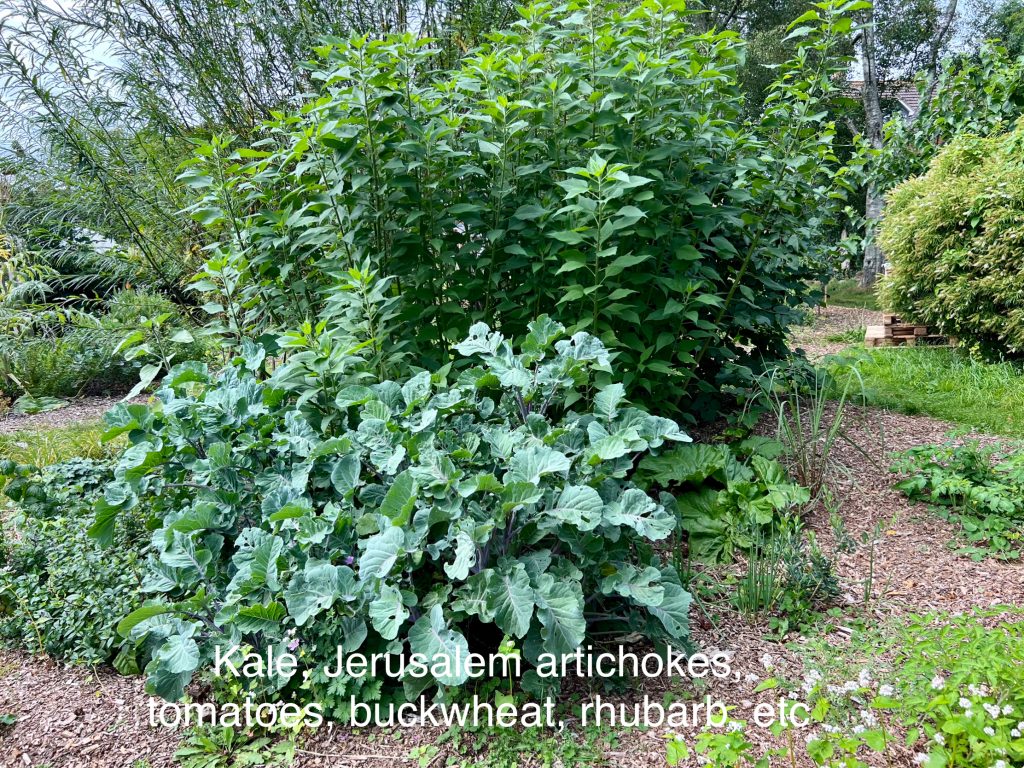
The following image is from our traditional food forest and lacks the linear nature described above. But we are about to start a linear food forest demo bed and will post articles and photos here about it as it is built and matures.
This makes much more sense; I have worked in food forests that were a nightmare to get any pruning, picking or tending done. Makes me claustrophobic just thinking about it!



This makes much more sense; I have worked in food forests that were a nightmare to get any pruning, picking or tending done. Makes me claustrophobic just thinking about it!
We are about to plant a few more linear strips