Gardeners Often Believe That Garden Beans Have a Short Season. But There Is One That Can Be Grown Every Day Of The Year. Discover Vicia faba Here .. And How To Grow It.
Table of Contents
Runner and French beans dislike the cold and die as soon as there is a frost. And some beans require more heat than we normally get in the UK. But Viciafaba can be grown all year.
What isViciafaba?
A hardy and versatile legume, Vicia faba is the broad bean and a favourite among UK gardeners. It is notably winter-hardy, often grown as a cover crop to prevent erosion and fix nitrogen in the soil. Tolerant of harsh conditions, it can thrive in heavy clay and saline soils, though it prefers a rich loam.
In the UK and other Commonwealth countries, the term “broad bean” refers to the large-seeded varieties grown for human consumption. Smaller, harder-seeded cultivars used for animal feed are traditionally called “horse beans” or “field beans.” In the United States, the Italian-derived name “fava bean” is more common.
But The RHS Say ….
The RHS have an extensive article on Vicia faba but only mention the broad bean. They also say it is harvested from May to August. That goes against everything I have ever learnt about gardening. They ignore the fact that V. faba includes a wide range of beans that can be eaten as beans OR as shoots and leaves in salads. They ignore their use as a cover crop and their use to prevent erosion and add nitrogen .. or at least they do in the above article!
Sowing Vicia faba 365/365
The truth is that the range of beans in the Vicia faba species can be sown 365 days a year and aren’t limited to using just as the mature seed of the broad bean. They can be sown outdoors all year .. though growth in December and January will be slower than the rest of the year. And they can be eaten as a salad crop every day of the year.
The speed of growth is extraordinary. In summer they germinate in days and the shoots can be harvested in days .. even quicker if grown on damp compost like you would grow mustard and cress. In winter the growth is slower but still faster than most other crops.
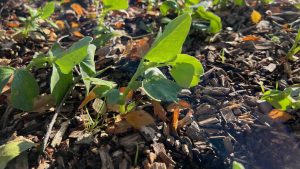
The field beans in this photo were planted just 6 weeks ago in October and the first to germinate have already been harvested. Pinch them out above there first few true leaves and many of them will reshoot later with a second potential harvest.
These are growing in a woodchip mulch in our food forest and clearly demonstrate how crops can be sown in woodchip with no detrimental issues.
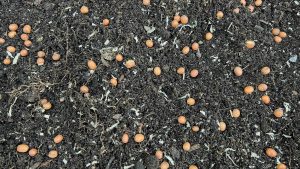
In the greenhouse I am densely sowing field beans in large containers (2-3 ft diameter containers can grow a lot of beans). The image shows how densely I sow them, they are covered with a little home made compost before watering and leaving to their own devices. Even with cooler conditions I should get reasonably quick germination, certainly within a couple of weeks of a mid November sowing and expect to harvest before Christmas. See below for a wonderful Christmas dish of creamy Vicia faba shoots with a selection of extras.
The great thing about these beans is that I can sow a handful in pots, containers or beds at any time and use them as shoots. Or I can leave them as green manures or cover crops to improve the soil with their nitrogen fixing roots. The tops can be used as a chop and drop crop at any time of year.
Farmers often grow these beans as a pigeon feed crop for harvesting. But it would be wrong to think that the smaller seeded field bean is only fit for pigeon feed (or cattle feed). But I prefer their flavour to broad beans .. they just happen to be more time consuming to harvest that the standard Aqualdulce, The Sutton and Masterpiece Green Longpod.
Vicia faba in its various forms are now grown in a huge number of countries. And its history goes back to the Neolithic era, with the oldest evidence found in Galilee, Israel, dating back over 10,000 years. I think it is a crop that is too often overlooked or only seen as a short season crop. What a waste of a valuable staple crop when it is limited in this way!
Creamy Vicia Faba Shoots with Pancetta and Chestnuts
This recipe combines the fresh, green vitality of the shoots with the rich, festive flavours of pancetta and chestnuts. The creamy Parmesan sauce brings it all together into a luxurious side dish that feels both special and comforting. My bet is not many readers will have tried this.
The vibrant green is a beautiful contrast on a plate often dominated by the browns of roasted meats and veg. It cuts through the richness of roast meats with its fresh taste. A wonderful mix of tender shoots, crispy pancetta, and soft, sweet chestnuts. Of course you could just eat it on its own. As an amuse bouche or an unusual starter. It goes well with a rich marsala wine!
PS the pancetta and cheeses are optional .. as are the nuts. In fact this is a very versatile dish, add or subtract whatever you like.
Yields: 4-6 servings as a side dish Prep time: 10 minutes Cooking time: 10 minutes
Ingredients
Vicia faba Shoots: 200g (about 7 oz), well rinsed
Pancetta: 75g (about 2.5 oz), diced into small cubes
Parmesan Cheese: 30g (1/3 cup), freshly grated, plus extra for serving
Lemon: Zest of half a lemon, plus a squeeze of juice
Nutmeg: A tiny grating (fresh is best)
Olive Oil: 1 tbsp (if needed)
Salt and Freshly Ground Black Pepper: to taste
Instructions
Crisp the Pancetta: Place the diced pancetta in a large frying pan or wok. Turn the heat to medium and cook, stirring occasionally, until the pancetta is golden brown and crispy. This should take about 5-7 minutes. Use a slotted spoon to remove the pancetta and set it aside on a paper towel, leaving the rendered fat in the pan.
Sauté Aromatics: If there isn’t much fat from the pancetta, add the tablespoon of olive oil. Add the minced shallot to the pan and cook for 2 minutes over medium heat until softened and fragrant. Add the minced garlic and cook for another 30 seconds, being careful not to let it burn.
Create the Cream Sauce: Pour in the double cream and add the chopped chestnuts. Bring to a gentle simmer, then immediately reduce the heat to low. Let it bubble very gently for 1-2 minutes until the cream thickens slightly.
Wilt the Shoots: Increase the heat to medium-high. Add the washed Vicia faba shoots to the pan. Toss them continuously in the hot fat for a few moments until they are just wilted and bright green. Do not overcook them—they should retain some texture. I often reserve a few to dress the dish at the end as well.
Combine and Finish: Quickly stir in the grated Parmesan, lemon zest and nutmeg (if used), don’t let the bean shoots over cook! Return the crispy pancetta to the pan (reserving a little for garnish if you like). Stir everything together until the cheese starts to melt and the sauce is creamy. Season well with salt (be careful, as the pancetta and Parmesan are salty) and a generous amount of black pepper. Finish with a small squeeze of fresh lemon juice to brighten all the flavours.
Serve Immediately: Transfer to a warm serving bowl. Garnish with the reserved pancetta, bean shoots and an extra sprinkle of Parmesan. Serve immediately while hot and creamy.