Modern Gardens Are Small, But Using Perspective & Optical Illusions in Garden Design Can Make Them Appear Bigger. This Article Reveals All.
Table of Contents
I recently posted photos of my garden and people remarked how big it was. But it was an idea built on optical illusions.
Actually it isn’t very big, I use perspective, trompe l’oeil, visual effects, tricks of light, colour and optical illusions to create the illusion of space. Let me explain.
I learnt many of these illusionary devices years ago. Soon after I started my marketing consultancy I was fortunate to be able to indulge my love of gardening by visiting events such as Chelsea in the guise of a journalist. I would attend on the press/preview day, interview designers and be allowed to go over the ropes and onto the gardens to take photos. Even the celebs weren’t allowed to do that!
Then I’d write my piece and submit it and my pics to my various magazine clients in the UK and overseas.
It was a wonderful opportunity to see how relatively small gardens create the illusion of space.
In this article I’ll explain some of the principles used in my garden to trick the mind in thinking its is much bigger than it really is. It’s really about perception and psychology that you will understand once explained and can use in any garden.
The Principles of Perspective & Optical Illusion in Gardens
Let’s start with your personal experience.
When you look into the distance what do you see? Do distant items appear the same size as nearby ones? Or do they appear visually smaller when further away? And do their colours appear as strong or do they appear muted or greyer in the distance?
Understanding the above is the key to designing gardens. In the next few paragraphs I’ll show both the theory and some examples that are based on these and a few other basic principles.
Perspective & Perception
If we look at railway lines going into the distance they appear to come closer together as they recede into the distance. Our brain is used to this and can use it to judge distance. We can use this in design.
Forced Perspective
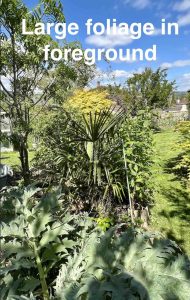
Large foliage in foreground
This classic trick makes things look further away by making them appear smaller as they go off into the distance. Large foliage or creatures in the foreground with smaller ones in the background emphasis this perspective.
Tapering Paths
Make your paths a tad narrower as they go further away from where you’re standing. This fools your eye into thinking the distance is greater.
Using Scale
The same thing happens if we put flower pots in a row running away from us. Put a large pot nearby, a middle size one further away and a small one beyond it and the brain is tricked into thinking there is far more distance than there really is. We can do this with plants as well. Size can deceive us and we can use that to create the illusion of distance and space.
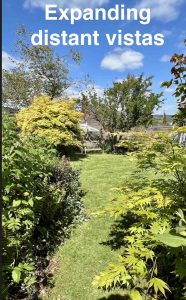
Another way to use space is to constrict a path with overhanging foliage so it looks narrow and to force the eye to look at an apparently larger area beyond. In this case the brain knows that distant objects look smaller so if it looks big the brain thinks it must bear very big.
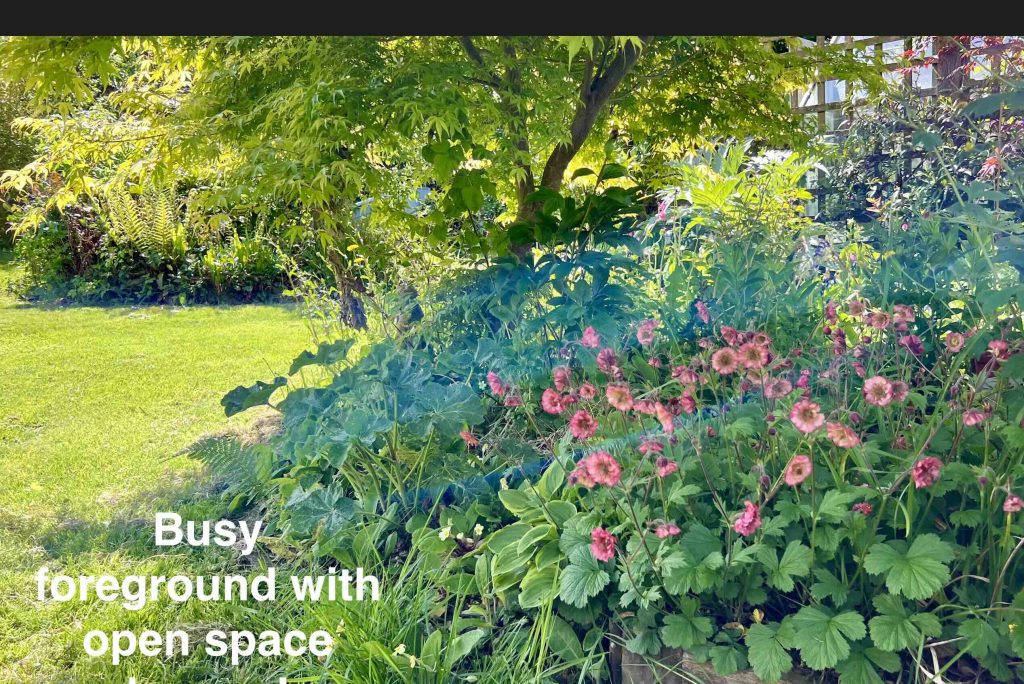
The balance between these visual tricks can be quite subtle and hard to achieve. In this case I have used an acer to overhang the grass path. It is a dissectum variety s has light feathery foliage. This accentuates the situation with the more solid looking lawn beyond looking much bigger as it is devoid of detail. It really isn’t nearly as big as it looks in the images. The fact it appears to go to both the left and right fools the brain even more … in this case I have stacked the illusion one on the other to make the brain see what really isn’t there. It is using the opposite tactic to reaching lines .. but still works.
Garden design is all about confusing the brain into seeing what isn’t there. Artists adopt similar tactics to produce what appears to be detail in a painting when all they really painted or drew was a squiggly line!
Expanding distant vistas
Using Detail to Confuse the Mind
Have more intricate bits in the foreground and simpler textures further back deceives the brain in to thinking the distances are greater than they are.
Lines Tell Lies
Our eyes naturally follow lines, so use them wisely.
Diagonal Lines
Think of it this way. Imagine a garden that measures 40ft by 30ft. What is the longest straight lines you can have in a garden of this size? Hint .. it isn’t 40ft. The longer straight line is between the diagonal corners and is 50ft. It is the classic 3:4:5 triangle! And you can have this effect from all four corners making a small plot look much bigger.
So, lay your paving, decking, or even your flower borders diagonally across the garden to make it seem bigger.
Curving Lines
Paths and borders that gently curve make the garden feel bigger by taking your eye on a longer journey and making you wonder what’s around the corner. Avoid straight paths that go straight to the edge, as this just shows how small the garden is.
Vertical Lines
Tall, slender plants or upright fencing can draw your eye upwards, making the space feel taller and less cramped. The sky is a long way away and adds a lot of space!
Size and Scale
Playing about with the size of things that repeat can make you think things are further away than they are.
Colour
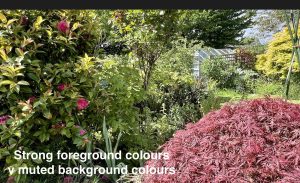
Strong foreground colours v muted background colours.
Cool Colours Recede: Use cool colours like blues, purples, and pale greens for plants at the back to make those areas look further away. Even lighter shades of the same colour works. So on a long pergola have deep red roses close by, pinks in the middle and blush in the distance. It extends the perception of space.
Warm Colours Advance: Use warmer colours like reds, oranges, and yellows for plants closer to you to make those features stand out and feel nearer.
Texture
Fine Textures in the Distance: Plants with small leaves and delicate textures tend to look further away.
Bold Textures in the Foreground: Bigger leaves and rougher textures look closer. Plants with bold architectural leaves such as Fatshedera and plain ivy on a tree or fence a bit further behind can work well.
Mirrors
If you’re careful, mirrors can make it look like you’ve got more space and depth. Angle them to reflect a distant path or plant.
Hidden Placement
Put mirrors where they’ll reflect plants or open areas, making it look like the garden goes on. An arched mirror covered in climbing plants can even suggest a secret bit beyond.
Don’t Reflect Walls Directly
This will just show you the boundary and won’t give the illusion of depth. Reflect spaces or plants.
Safety: Keep an eye out for birds and don’t put mirrors where they might fly into them. Also, avoid direct sunlight reflecting off them as it could potentially be a fire risk.
Other Garden Design Methods to Make Your Garden Feel Bigger
Apart from optical illusions, there are other design ideas that can make a small garden feel more spacious:
Vertical Planting
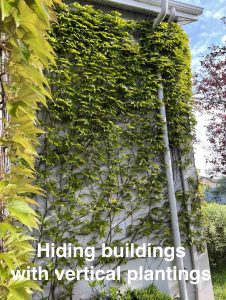
Hiding buildings with vertical plantings
Use your walls, fences, and other structures to grow plants upwards. This frees up ground space and makes you look upwards, so the garden feels less squashed. It also hides buildings and unsightly features.
Think about living walls, climbing plants on trellises, and hanging baskets.
Zoning
Split the garden into different “rooms” or areas for different things. This breaks up the view and makes it feel bigger because there’s more to explore. Use different paving, levels, or low hedges to mark these areas. And use curving paths between them so there is always a secret beyond.
Softening Boundaries
Hide the edges of your garden to make it feel like it goes on further. Use tall, bushy plants along fences or walls to soften them and blend them into what’s around. Using similar plants or design ideas as your neighbours can also make it feel like one big space.
Borrowed views
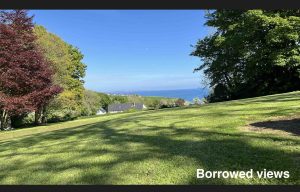
Borrowed viewed views are a garden optical illusion
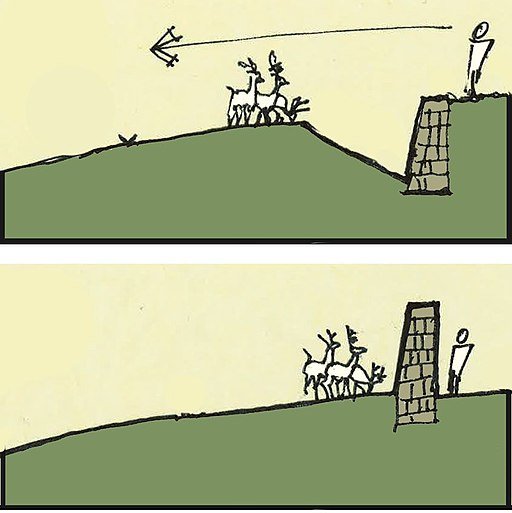
The opposite of the above also works. By removing boundaries we can create the illusion that they don’t exist. And that our gardens reach far into the distance. If you are lucky your garden could reach the sea… just like the garden in this photo. This is similar to the use of a haha in large country houses where the lawns apparently merge into the fields beyond. There are no hedges to stop the eye. The livestock boundary is the hidden ditch or haha.
Creating Layers
Plant things at different heights to add depth and interest. This stops you from seeing the whole garden at once and makes you feel like you’re going on a bit of a journey.
Choosing Furniture To Create Optical Illusions
Carefully: Go for smaller, lighter bits of furniture that don’t take up too much space. Pick things with clean lines and avoid anything too bulky. Think about furniture that does more than one job, like benches with storage.
Outdoor Lighting
Good lighting can really change how big your garden feels at night. Lighting up trees or features further away can create a sense of depth and draw your eye outwards.
Keeping Things Tidy
A cluttered garden will always feel smaller. Keep your lawn mown, your borders neat, and get rid of anything you don’t need to make it feel more ordered and spacious. Being minimalist in the garden has benefits UNLESS you use the busier effect to create optical illusions such as when you haver large leaves close by and small leaves further behind.
Creating Focal Points
Put interesting things in key spots to draw the eye and create a sense of depth. This could be a statue, a water feature, or a striking plant. Place them so they lead your eye through the garden. Paths that meander or recede into the distance can work in this way.
Using Different Levels
Even small changes in level can add visual interest and make a small garden feel bigger. A slightly raised patio or a few steps can break up a flat garden. I recall one garden we built by a college I was working with that had a stainless steel raised deck one end with meandering path leading back to it. The illusion of distance was helped by the path getting narrower as it receded. And the plants at the front had larger leaves.
We knew it was a winner when Alan Titchmarsh featured it on Gardeners’ World. The RHS invited the designer to enter a garden at Chelsea the following year (Chelsea gardens are all designed by people that have won Gold medals at “lesser events” and have been invited to submit a design for approval).
Coordinating Colours
Choose a colour scheme that works well together for your plants and hard landscaping. Too many clashing colours can make a small space feel busy and smaller.
Garden Optical Illusions … Conclusions
I hope the move demonstrates how by cleverly mixing optical illusions with good garden design ideas, you can definitely make a small garden feel much bigger and more inviting than it actually is.