The “Good Crop” Myth & Mirage: Allotment Psychology & What “Good” Really Means
Gardening Websites & Social Media Groups Want To Promote Good Gardening Practices & Encourage Newbies. We Welcome Their Photos and Questions & Want To Be Positive. So How Can We Overcome The Good Crop Myth?
Table of Contents
Someone on a Facebook gardening group recently asked about topping out their tomatoes as they have reached the roof in their greenhouse .. this was in late May! They went on to say they were delighted with the plants that were looking good with a great crop of toms. On looking at the photos the cordon plants had reached the roof and had three trusses of 3-4 toms per truss on each plant. They were leggy, lots of flowers hadn’t set and the fruit looked very poor. It screamed an abysmal crop to me, but as social media group admins we are here to encourage people and that’s what I try to do. The “encourager” in me had to think about how to delicately and politely find the good points about the crop whilst gently suggesting they were leggy and poor yielding .
Part of me wanted to scream that this was an awful crop, but the polite educator in my won and I gave praise for an early crop whilst suggesting a few techniques that would give an “even better” crop next year. As group admins and educators our job is to encourage, NOT rubbish growers, whether newbie or well established.
What Is A Good Crop?
Scrolling through UK gardening groups, declarations of “fantastic yields” and “record harvests” are rife. But what is a “good” yield? For many UK gardeners, the benchmark isn’t commercial data or seed packet promises – it’s Dave’s blighted plot next door or last year’s washout season. This reliance on flawed comparisons, mixed with powerful psychological biases, creates a potent illusion where mediocrity feels like triumph and genuine potential goes unseen. Let’s unravel this allotment enigma.
Of course we should not compare garden and allotment yields with commercial cropping. It would negate the pleasure of growing our own, the chance to be out in the fresh air, the social aspect and mental health benefits. In a world where doctors are prescribing gardening as a way to decrease stress and blood pressure it is not our job to increase it! But equally we can, and I would argue should, encourage people to grow “good” crops where they can. Not least because it makes the growing of them even more enjoyable. And maybe also because it is no more effort to get a crop, such tomatoes or potatoes, to yield well as to produce a rubbish yield.
Plus, in many cases, there is an economic imperative. Often I see people spending large sums of money on fancy kit that will not grow better crops, they will just lighten a wallet. From my experience as a commercial grower I know a lettuce is just as “happy” growing in an old greenhouse as in a “glass palace”. In fact, for lots of reasons, the old house often produces better crops!
Why Do People Fall For The Great Crop Mirage?
None of us want to be gardening failures. We want great crops and perhaps to be able to win prizes at the local flower and veg show. Indeed many of the people reading this article will have posted their successes on Facebook or similar.
There are several psychological reasons for claiming success .. even where failure looks us in the face. Here are just a few.
The Flawed Benchmarks & Psychological Traps:
The “Dave Effect” (Social Comparison): “My toms smashed it… way better than Dave’s!” If Dave’s plants are neglected or disease-ridden, even leggy tomatoes with sparse trusses (just 3-4 fruits where 8-10 is ideal) feel like a “great crop.” The problem? Dave might be a terrible benchmark. Neither of you may have ever seen a truly optimal plant. This applies broadly: your spindly runner beans setting only a few pods feel “great” compared to a neighbour’s total failure.
The “Better Than 2023” Fallacy (Temporal Comparison): “My spuds were brilliant… miles better than last year!” If 2023 saw late frosts or a slug Armageddon, any improvement feels monumental. Surviving a wet summer with some un-blighted tomatoes or a handful of carrots becomes a “bumper yield,” even if plants were stressed and performed far below potential.
Confirmation Bias (The Rose-Tinted Trug): This is crucial. We actively focus on what went right and downplay the rest. You photograph that one perfect tomato truss with 4 flawless fruits (hiding its leggy stem and sparse neighbours). You post it. You remember it. You mentally file the season under “success.” Meanwhile, you ignore the courgettes that succumbed to mildew after two fruits, the beetroot riddled with borers, or the overall meagre weight of the harvest. That single success becomes proof of a “great crop,” overshadowing widespread underperformance.
The “Any Harvest is a Win” Low Bar: After battling UK weather or pests, simply getting something edible feels victorious. A trug of small, split tomatoes or forked carrots gets labelled a “great yield” purely because it exists, setting an unintentionally low standard.
Effort Justification: “I worked so hard, it must be good!” The sweat equity poured in makes us need to perceive the result as “great,” regardless of measurable output.
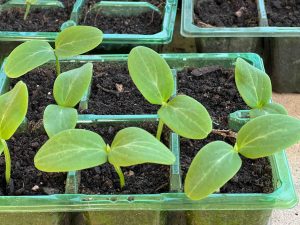
It is easy to be tempted to show images of perfect crops. But none of us produce perfect crops ALL the time. Take the image of these recently germinated cucumbers. They look great. Six Marketmore cue seed went in the three cells and all six germinated. Perfect!
Now look at the cells in the row behind. Six seed of another variety went in and ONE germinated. All other factors were the same, compost, temperature, watering etc. Dishonest gardeners would show you only the front row. But I wanted you to see that we all get failures. As a commercial grower I would often sow lettuce into a batch of 10,000 modules and every single one germinated. We had very good equipment and knew exactly what we were doing, We expected perfection every time! But just occasionally we got it wrong, we had a failure of some sort. Never in my experience as bad as five out of six seeds not germinating .. that’s a first for me .. but perfection wasn’t guaranteed. To over come it I would usually sow 1-2% more seeds than I needed. It meant some sort thrown away each time but that is better than not having enough.
Verifiable “Good”: Beyond Dave and the Memory of Rain
Forget the skewed comparisons. Objectively good results, across crops, are measurable and are tied to potential success. Depending on variety and other factors we should look for …
Tomatoes: Not just surviving blight, but well-filled trusses (8-10+ fruits consistently on cordon varieties) on sturdy plants (not leggy). High fruit set (ideally 100%) indicates good pollination, nutrition, and environment. Total yield per plant and per square metre matters more than one showpiece truss. Flavour and minimal defects (splits, BER) are key. Often people tel me they had hundreds of tomatoes last year. But fail to say how many plants and if they were a good size for the variety. Here are my tips on How to Grow Tomatoes.
Runner Beans: Not just having flowers, but heavy setting (say, 15+ pods per stem) over a long season. Good pollination and consistent moisture are critical.
Root Crops (Carrots, Beetroot): A high density of usable roots – good germination, minimal forking/cracking, decent sizing. A patch full of uniform, blemish-free roots is better than a few giants surrounded by failures.
Courgettes:Steady, prolonged production (not just one glut then mildew. ), high fruit set , good flavour without bitterness.
Potatoes:High yield per seed potato with minimal scab, blight, or slug damage. Good size distribution.
Universal Metrics:
Long Season: farmers want crops that can be machine harvested with all the crop ready at once. It is efficient farming. As gardeners a crop this is a bit uneven with a long harvest season is much better. We really don’t want 20 cauliflowers ready the dame day!
Fulfilling Potential: Did the variety perform as expected in your specific conditions? (RHS/seed packet guides help).
Consistency: Was production steady, with all crops giving good sizes and quality?
Quality & Usability: High percentage of sound, flavoursome, harvestable produce.
Resource Efficiency: Did the output justify the water, feed, compost, and time? A crop needing constant fungicide isn’t a sustainable success.
Efficiency: Yield per plant or per unit area. Ten leggy tomato plants yielding the same as four well grown, compact, well-fruited ones is inefficient.
Bridging the Gap: Cultivating Realistic Success
Base your crop expectations of reality, not Dave from the next plot. Here are a few ideas how …
Seek Better Benchmarks: Visit high-yielding plots, study RHS trial results, look at reliable seed packet data (as a potential guide). Ask successful growers specifics: “How many kg per plant of ‘Sungold’?”, “How many pods per runner bean stem?”, “What’s your carrot spacing/yield?”
Track Your Data Relentlessly: Weigh harvests per plant/variety. Count fruits per truss on multiple trusses/plants. Note germination rates, pest damage, plant health. Compare your results year-on-year with detailed notes on conditions and inputs.
Combat Confirmation Bias: Actively assess the whole picture. Examine allthe trusses on your tomatoes, not just the best. Acknowledge leggy growth, sparse sets, or pest damage as areas for improvement, not just hidden wins. Did most plants perform well, or just a few?
Define Success Objectively: Set goals based on plant potential, not just beating Dave or last year. “This season, I aim for 8 fruits per truss on ‘Shirley’ toms by improving pollination, watering and nutrition” or “I want 80% germination and minimal forking in my carrot bed through better soil prep.”
Celebrate Genuine Improvement & Skill: Going from 2 to 5 fruits per truss? Fantastic progress! Mastering blight prevention? Huge! Recognise these as steps towards potential, not the final destination, because the year after you should aim for 100% fruit set on your toms
Contextualise Social Media: Enjoy the lovely harvest photos, but ask: “How many plants? Over what time? What was the plant health like overall? What inputs were needed?”
The Takeaway:
A “great crop” on the UK allotment is often defined by relativity (beating Dave or last year) and distorted by confirmation bias, where we focus on the wins and ignore the wobbly plants or sparse trusses. True success lies in understanding a plant’s genetic potential, measuring your results against that benchmark (using data, not just memory), and striving for healthy plants, efficient space use, and reliably full trusses (or pods, or roots!). It’s about moving beyond the illusion of the “bumper crop” photo towards the sustainable satisfaction of genuinely productive, well-managed ground.
Put the kettle on, grab your notebook, and look at your plot – and Dave’s – with fresh, critically kind eyes. The path to real great yields starts now.
PS wonky veg is just as tasty as perfect veg. Don’t ditch it, enjoy it .. but try to grow better next time.
Thanks Karen. So many people have no real understanding of what good crops look like and pit themselves against poor levels. If they are happy with it then fine. But often they dont know.



Love this post. So enlightening and relevant to big and small growers.
Thanks Karen. So many people have no real understanding of what good crops look like and pit themselves against poor levels. If they are happy with it then fine. But often they dont know.