Free Heat? The Jean Pain System: Harnessing Large-Scale Brushwood Composting for Domestic Heat
Table of Contents
People often suggest heating their greenhouses or homes with the waste heat from their compost heaps. It is a compelling idea, heat at nil cost. Fuel for Free? But what is the reality? This article explains the issues.
Free Heat: The Reality of the Jean Pain System
Can houses and greenhouses be heated with waste heat from a compost heap? In theory yes, as the work of Jean Pain shows. But on a small scale the problems are almost insurmountable for most people.
Jean Pain (1928–1981) was a Swiss-born French innovator and forest manager who developed a revolutionary method of extracting heat and biogas from brushwood compost. His work remains a cornerstone of permaculture and sustainable energy research, particularly through the “Jean Pain Mound” (or Biomeiler), which provides a carbon-neutral alternative for residential heating
The Jean Pain Heating System
The system relies on the aerobic decomposition of woody biomass. Unlike traditional garden composting, which focuses on kitchen scraps and green waste, Pain used “brushwood”—shredded tree limbs and undergrowth.+1
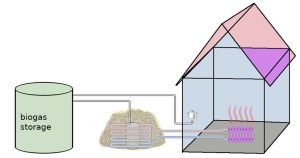
Heat Extraction: A closed-loop hydronic system (plastic piping) is coiled throughout the heap. Water circulating through these pipes absorbs the heat generated by microbial activity and carries it into a home or greenhouse.+1
Methane Production: In his original designs, Pain often placed a sealed steel tank in the centre of the heap. The heat from the outer aerobic pile would warm the inner tank to approximately 35°C, facilitating anaerobic digestion to produce methane gas for cooking or powering engines.
End Product: After 12 to 18 months, the heap decomposes into high-quality humus, providing a significant volume of fertilizer.
Relevance for Residential and Small Garden Situations
For a small garden, the primary challenge is the physical scale required to maintain the high temperatures necessary for domestic heating.
Thermal Mass: Small heaps (under 1–2 m³) lose heat too quickly to the atmosphere to be effective for anything more than heating a small hot tub or a very small greenhouse bed.
Residential Reality: To provide enough energy for a typical family home’s space heating and hot water, the heap must be substantial. It is often described as the size of a “small garage.”
Feedstock Demand: A residential system requires tonnes of wood chips. This makes it highly practical for those with access to woodland or local arboricultural waste, but less feasible for a typical urban garden.
Size and Figures: The “Power Heap”
To generate sufficient heat for a household throughout a cold winter, the following parameters are generally required:
Feature
Requirement for a Household System
Volume
Typically 30 to 60 cubic metres (approx. 50 tonnes of material).
Dimensions
A mound roughly 5–6 metres in diameter and 2.5–3 metres high.
Piping
200 to 400 metres of polyethylene or copper pipe coiled inside.
Heat Output
Capable of producing 4–10 kW of continuous thermal power.
Temperature
The core of the heap stays between 55°C and 65°C.
Duration
A well-built heap of this size can provide usable heat for 12 to 18 months.
Key Calculation: Academic research into modified Jean Pain mounds has shown that a 31 m³ heap can recover roughly 10,550 kJ/hr (approx. 2.9 kW) over a 12-month period. For a standard UK home, which may require a peak load of 6–8 kW in mid-winter, a single mound may need to be exceptionally large or supplemented by other sources.
Doubts and Considerations
Labour Intensive: Building a Jean Pain mound is a major physical undertaking, often requiring a tractor or many days of manual labour to shred and stack the material correctly.
Moisture Management: The heap must be thoroughly saturated during construction. If it dries out, the biological “fire” goes out; if it is too wet, it becomes anaerobic and smelly.
Space: In a small garden, the footprint of a 5-metre diameter mound (roughly 20 square metres) plus access for the material is often prohibitive.
This video provides a practical, visual guide on constructing a Jean Pain-style system for greenhouse and domestic use, illustrating the scale and labour involved. The video style is American homesteading!