In Gardens, Allotments & Food Forests Designing for Resilience & Biodiversity Is Essential. Doing So Increases Yields, Flavour, Resilience & Biodiversity.
Table of Contents
A fundamental concept in permaculture, which underpins the design of a biointensive green or food forest, is the crucial importance of biological diversity. Think of a natural forest; it contains a wide variety of plants, animals, and fungi, not just one or two types. This biological diversity is what makes the system robust and resilient. For a food forest, this means having many different species of plants, from trees to ground covers. This variety is your insurance policy against the unpredictable effects of climate change, which can bring unusually hot, wet, or dry weather. If one plant variety struggles in a difficult season, others will likely thrive, ensuring you still get a consistent yield and the overall system remains healthy. The same prohcip;e applies to fruit and veg gardens .. though few people understand this or practice it.
Ecological Balance Through Strategic Planting
This approach actively promotes a healthy ecological balance. Rather than a monoculture (growing just one crop), you create a mini-ecosystem. This is achieved through strategic interplanting, which means planting different species close together in a way that benefits them. In effect you produce a plant guild.
For instance, you can plant flowers that naturally attract helpful insects that eat common garden pests. In the UK, these include ladybirds, lacewings, and hoverflies, which are all natural predators of aphids. You also attract a wide range of pollinators, like native bees and butterflies, which are essential for fruiting plants. Choosing plant varieties that are known to be disease-resistant from the very beginning reduces the need for chemicals or other interventions later on. This method shifts the focus from reactively killing pests to proactively designing a system that manages itself. The goal is not to eliminate every pest but to foster a complex, self-regulating food web where predators keep pest numbers in check, protecting your plants from serious damage. This minimises the amount of manual labour and external inputs you need to add to the system. It requires a mindset shift from “killing pests” to “supporting natural controls” and accepting a certain amount of natural damage as a sign of a healthy, balanced ecosystem. An other example of post control using this method is to encourage ground beetles that will control slugs. More beetles, fewer slugs.
Ecological Connectivity With Veg & Food Forests
Beyond your thinking bout our immediate garden, allotment or food forest, it is vital to consider the wider landscape. You should design for ecological connectivity. This means making sure your food forest isn’t an isolated island of nature but is linked to the surrounding environment. In the UK, this can be done by incorporating features like native hedgerows and woodland edges. Hedgerows, for example, act as vital corridors and “stepping stones” for wildlife, allowing species to move and spread, countering habitat fragmentation which is a major issue across the UK countryside.
Many people imagine that this means long lengths of liner hedges meandering across the landscape so that mice, reptiles and inc=sects can move along them. But life is rarely ideal and short gaps between landscape features can still be crossed by flying insects, mammals and birds. So don’t imagine that a site needs to be contiguous. Short gaps can work nearly as well. And when it comes to birds the distances can be very big.
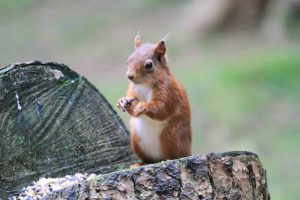
Interestingly, as I write this article I have seen a squirrel in an isolated group of trees nearby. I wondered how it had reached the trees across the surrounding fields and roads. Then I observed it leaving. It jumped onto a telegraph pole and then ran along the wires for over 100 metres before jumping into another large isolated tree! Nature often finds a way.
When Designing for Resilience and Biodiversity this holistic approach ensures your food forest, garden or allotment contributes to the wider ecological health of the area, strengthening local biodiversity and regional nature networks. The most resilient food production areas are those that work with nature, not against it, by fostering a complex, self-regulating ecosystem that reduces the need for human labour and external inputs.