The Bradninch Black Apple: My Mission to Unravel and Preserve Devon’s Red-Fleshed Mystery. Could It Be Just a Single Tree Hidden In History? Or Is There More TO This Enigmatic Apple?
Table of Contents
A Tasty Hidden Secret
The ‘Bradninch Black’ (Malus domestica ‘Bradninch Black’) is an apple that stands as one of Devon’s most enigmatic heritage varieties. Hailing from my hometown of Bradninch, near Exeter, Devon, this apple is striking for its sharp culinary qualities and distinctive colouration. Yet, the story begins with a remarkable admission: this was a secret hidden in plain sight.
My Apple Confession!
No, it’s not a confession about scrumping apples when I was a child. This one goes far deeper, back in the annals of apple lore.
I am the fourth generation of my family from Bradninch so we should know about the Bradninch black apple. My grandfather even had orchards nearby, but as I’ve pursued this variety, I realised: “It was such a good secret that I had never heard of it… I recall no mention of this variety!”
The fact that this unique fruit—prized for its ornamental appeal and the intense red purée it yields—was effectively lost, even to families with deep local roots in horticulture and farming, underscores just how precious and precarious its existence has become.
A Botanical Clue from Central Asia
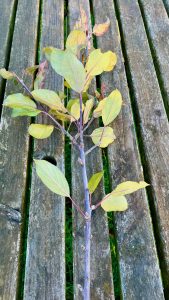
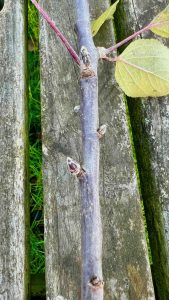
The ‘Bradninch Black’ is no ordinary apple. Its pervasive pigmentation—rich red skin, unique pink flesh, and highly ornamental dark, purple-red young stems and foliage—is a powerful botanical clue.
This colouring strongly suggests a genetic link to Malus niedzwetzkyana, a wild species native to the Tian Shan mountain range of Central Asia.
See the update below, received since this article was written
This realization focused my research efforts: “Clearly the BB is a unique variety, and links to the Tian Shan mountains of China have to be a possibility, with a 19th century introduction likely.” Given the scarcity of true ‘black’ or deep-red-fleshed apples globally, tracing this origin has become a personal mission.
I have spent time searching historical plant catalogues, including those from Veitch and other plant hunters. The trail points toward the collectors who were active in the Tian Shan area, such as the Russians and Germans, including Regel and Lipsky, who were collecting apple ancestors like Malus sieversii. “So I wonder if the Bradninch variety came via Russia or Germany”. Finding the exact moment this unique genetics arrived in Devon remains the next major challenge.
A Preservation Strategy in Sidmouth
The ultimate goal, however, is not just discovery, but survival.
“My interest now is to preserve the variety in a location where it is assured care for years”. Since moving to Sidmouth, I have become heavily involved in local environmental projects, which provides the perfect solution for the Bradninch Black’s future.
I currently work with the Sidmouth Civic Arboretum, which maps over 700 notable species. I also started the Sidmouth Community Food Forest, which has Town Council support and includes a traditional orchard.
The plan is to safeguard the apple by establishing it across multiple sites: “We would like to add a Bradninch Black or two to our collection on several sites to give more certainty to its future.”
By securing specimens and planting them in the Civic Arboretum and the Food Forest, we can ensure that this extraordinary piece of Devon’s horticultural heritage will not be forgotten again, allowing its story—and its crimson purée—to thrive for generations to come.
Update…. DNA results are now available … see the appropriate section below.
My Bradninch Black Research Notes
Below are the notes I made as I researched this enigmatic apple. The above is a more concise version but the following contains far more detail and has taken months to collate. Bear with me where various sources repeat the basics. Part of the fun in horticultural and botanical research is wading through reams of data looking for the gems. Gems that are little clues to bigger secrets and revelations that have been hidden for years. Often it takes me down rabbit holes and into rural cultures de sacs. But sometimes we discover something that is completely new or has been lost to gardening and science for many years.
Bradninch Black Apple Key Characteristics
Origin: Bradninch, Devon.
Fruit Appearance: The fruit is described as rich red with strongly pink flesh. Despite the ‘Black’ in the name, it refers more to the dark, purple-red pigmentation extending through the tree’s structures.
Tree/Foliage Appearance: The tree is particularly ornamental. It features dark, purple-redyoung leaves, stems, and blossom, making it an attractive addition to a garden or orchard.
Flavour and Use: The fruit has a sharp flavour, which means it is best used as a cooking apple. When cooked, it produces an ‘amazing red purée’ due to the pink flesh.
Botanical Notes: The variety is sometimes suggested to be related to ‘Wisley Crab’, which is a form of Malus niedzwetzkyana, a species known for its red-fleshed, red-flowered, and purple-leaved characteristics, originally from the Tien Shan mountains of China. This potential lineage would explain the unusual deep colouring of the Bradninch Black.
RHS Recognition: It is listed by the Royal Horticultural Society (RHS) as a ‘Plants for Pollinators’ plant, indicating it provides nectar and pollen for pollinating insects.
In summary, the Bradninch Black apple is a heritage Devon cooking variety celebrated for its unique dark red/pink flesh and the ornamental value of its purple-red foliage and blossom.
More notes ….
Origin and Potential Sources
The Bradninch Black apple is named after the town of Bradninch in Devon, where it is believed to have “originated” Author note .. it is unlikely to have just appeared here spontaneously. A Chinese source is far more likely .. but is this evidenced anywhere? . A key detail in its history is the suggestion that it may be related to Malus niedzwetzkyana, a species of wild apple from the Tien Shan mountains in China. This theory, mentioned by growers and botanical organisations such as the Royal Horticultural Society (RHS), is supported by the apple’s unusual dark red or purple-red young leaves, stems, blossom, and pink-tinged flesh, which are characteristics of Malus niedzwetzkyana. This species was introduced to the UK in the 19th century, notably through varieties like ‘Wisley Crab’. This suggests a potential link, but a direct line of descent is not definitively proven.
There are no widely available academic or historical sources that place the Bradninch Black apple in 19th-century sales catalogues or gardening books under that specific name. The apple’s history appears to be more local and anecdotal, with its recent rediscovery and propagation driven by enthusiasts.
Potential Synonyms and Other “Black” Apples
It is a common phenomenon for apple varieties to have multiple names or for different varieties to share a similar name. While a direct synonym for ‘Bradninch Black’ has not been widely recorded, it is worth investigating other historic “black” apples to see if there is any shared lineage or if the name was a local descriptor. Other well-documented ‘black’ apples include:
Kingston Black: A famous vintage-quality cider apple from Somerset, UK, which was widely grown in the West of England by the 19th century. Its name comes from its dark red or purplish skin, though the fruit is not truly black.
Black Oxford: An heirloom apple variety from Maine, USA, with a dark purple or “blackish” colour.
Arkansas Black: A long-keeping, tart apple from the USA, which darkens to a nearly black colour in storage.
While these varieties share a similar descriptive name, there is no evidence to suggest they are the same as the Bradninch Black. The unique characteristics of the Bradninch Black, particularly its pink flesh, set it apart.
Further Research Questions
To further a historical and academic understanding of the Bradninch Black apple, the following questions should be considered:
Genetic Analysis: Has a comprehensive DNA analysis been performed to definitively trace the apple’s genetic lineage? This would confirm its relationship to Malus niedzwetzkyana or any other known cultivars.
Local History and Oral Tradition: What local historical sources, such as parish records, old farm ledgers, or local horticultural society documents, might mention a dark-skinned apple from the Bradninch area? Have any oral histories from local families been collected regarding the tree or its fruit?
Horticultural Collections: Are there records of the Bradninch Black being held in any historical or modern fruit collections, such as the National Fruit Collection at Brogdale? Checking these catalogues might reveal its first documented inclusion in a formal collection.
Taxonomic Classification: Is the classification of the Bradninch Black as a separate variety formally recognised or is it considered a landrace or sport of another type? The RHS currently lists it as Malus domestica ‘Bradninch Black’, but with an ‘Unresolved’ status, which indicates its classification is not yet definitive.
Cultivation History: When and by whom was the original tree first propagated? Is it a single surviving “mother tree,” and if so, what is its estimated age?
Further thoughts and proposals
The ‘Bradninch Black’ Apple: History, Taxonomy, and a Proposed Research Agenda
Introduction: A Devonshire Enigma
This report provides an in-depth analysis of the ‘Bradninch Black’ apple, a distinctive heritage variety native to Devon, England. The investigation is driven by a series of detailed inquiries regarding its origins, lineage, presence in historical records, and potential confusion with other varieties. The objective of this report is to synthesise available contemporary information, apply a structured comparative and analytical framework, and, most importantly, identify critical gaps in knowledge that necessitate further research. By adopting an expert-level approach, this document aims to transcend a simple compilation of facts, instead offering a nuanced perspective that frames the ‘Bradninch Black’ within a broader narrative of horticultural history and genetic conservation.
Core Characteristics and Documented Origins
A foundational understanding of the ‘Bradninch Black’ apple requires a detailed description of its unique attributes and a precise confirmation of its contemporary documentation and origin. This section establishes the known facts about the variety.
Defining Attributes: Appearance and Culinary Application
The ‘Bradninch Black’ apple tree is remarkable for its striking and consistent pigmentation, a characteristic that sets it apart from more common apple varieties. Described as “beautiful” by one source, the tree’s young leaves, stems, and blossoms all exhibit a “dark, purple-red” colouration. This is a noteworthy phenotypic trait, as the purple-red color of the foliage and flowers is a direct extension of the same pigment responsible for the fruit’s unique appearance. The fruit itself is vibrant red and possesses a “strongly pink flesh”.From a culinary perspective, the ‘Bradninch Black’ is a specialist apple. Its flavour is described as “sharp,” which renders it less suitable for fresh consumption. Instead, it is highly valued as a cooking apple, particularly for its ability to produce an “amazing red puree” when cooked. This high acidity and pigment retention are desirable qualities for specific culinary applications, especially in the context of traditional English cooking. The presence of anthocyanin compounds is directly responsible for the intense red colouration in both the skin and flesh. These compounds are part of a larger class of molecules called flavonoids and are not only key to the apple’s visual appeal but also believed to possess significant antioxidant properties.
The Contemporary Record: Pinpointing its Origin
The documentation of the ‘Bradninch Black’ in the modern era firmly places its origin in a specific locality. Its provenance is consistently cited as “Devon (Bradninch near Exeter)”. The variety is listed by reputable horticultural organisations, such as the Royal Horticultural Society (RHS), which categorizes it as Malus domestica ‘Bradninch Black’. The RHS provides detailed cultivation information, noting it as a deciduous tree with a spreading habit that can reach a height of 4-8 meters and an ultimate spread of 4-8 meters, typically within 10-20 years. It is rated as H6, indicating hardiness across the UK and northern Europe, and is recommended for sunny, sheltered locations with well-drained, neutral soil.The existence of the ‘Bradninch Black’ in contemporary nursery and botanical listings suggests a recent formal documentation and reintroduction into the horticultural marketplace. This is a crucial point, as the absence of a detailed historical record (discussed in a subsequent section) is itself a significant data point. The current availability of the tree, propagated on various rootstocks like M9, MM106, and M25, signals a successful modern conservation and commercialisation effort. This re-emergence from local obscurity is a common theme in the world of heritage fruit conservation, where varieties once confined to a single garden or community are now being propagated and shared more widely.
Investigating the “Black” Connection: Taxonomy and Lineage
A central part of the user’s inquiry concerns the ‘Bradninch Black’s’ likely lineage, particularly a potential connection to a wild Asian progenitor. This section explores that hypothesis and then distinguishes the variety from other similarly named apples to clarify any issues of synonymy.
The Hypothesis of Malus niedzwetzkyana
The most compelling assertion about the apple’s origin is that it is “Possibly related to ‘Wisley Crab’, a form of Malus niedzwetzkyana introduced to the UK direct from the Tien Shan mountains of China in the 19th Century”. This is a profound statement that moves the apple’s story from a local curiosity to a part of a global horticultural lineage.The wild species Malus niedzwetzkyana is a small apple tree native to Central Asia, specifically parts of China, Kazakhstan, Kyrgyzstan, and Uzbekistan. This species is renowned for its all-encompassing red pigmentation, which saturates its flowers, leaves, shoots, and fruit flesh. This trait is not merely a superficial quality; it is a genetic signature. The colouration is driven by the accumulation of anthocyanins, a process regulated by specific transcription factors. The most notable of these is the MdMYB10 gene, whose presence and expression are directly responsible for the “type 1 red-flesh phenotype” observed in M. niedzwetzkyana and its progeny. The pervasive purple-red pigmentation described for the ‘Bradninch Black’—in its leaves, stems, blossoms, and flesh—is precisely the kind of phenotypic expression that a genetic lineage from M. niedzwetzkyana would produce.
The link is made via ‘Wisley Crab’, which is identified as the likely conduit for these genetics into the UK. ‘Wisley Crab’ is also noted for its red leaves and pink-fleshed fruit, reinforcing its connection to the Asian progenitor. The introduction of M. niedzwetzkyana to the West in the late 19th century—specifically to Germany around 1890 and then to the US and UK soon after—provides a plausible timeline for these genetics to have entered European cultivation and potentially resulted in a chance seedling like the ‘Bradninch Black’. The existence of this wild species, which is currently classified as endangered in its native habitat, makes the ‘Bradninch Black’ a valuable example of its genetic legacy.
Comparative Pomology: Distinguishing ‘Bradninch Black’ from Other “Black” Apples
The user’s inquiry into whether ‘Bradninch Black’ might be the same variety as another with a different name is a critical question in pomology. A comparative analysis of other varieties with similar names definitively shows they are distinct.
Variety Name
Origin
Approx. Date
Flesh Colour
Primary Use
Distinguishing Feature
‘Bradninch Black’
Bradninch, Devon, UK
Unknown/Unrecorded
Pink
Cooking/Puree
Purple-red leaves, stems, and flowers
‘Arkansas Black’
Benton County, Arkansas, USA
c. 1870
White/Cream
Fresh/Storage
Dark, almost black skin; excellent keeping quality
‘Black Oxford’
Oxford County, Maine, USA
late 1700s
White/Cream
Fresh/Storage
Extreme cold-hardiness; flavor improves with storage
‘Kingston Black’
Somerset, UK
Unspecified historical
White/Cream
Cider
Bittersharp profile; single-varietal cider apple
NB All the above EXCEPT Bradninch Black have white or cream flesh
The ‘Arkansas Black’ is a well-documented American variety that originated in Benton County, Arkansas, around 1870. While it shares a “black” name and a dark red skin that can deepen to a blackish hue, its flesh is not described as pink. It is also believed to be a seedling of ‘Winesap’ and is prized for its long storage life and disease resistance, a different profile from the ‘Bradninch Black’. Similarly, the ‘Black Oxford’ is another American heirloom, a cold-hardy and disease-resistant variety discovered in Maine in the late 1700s. Known for its mild, sweet flavour after storage, its different origin and sensory profile confirm it is a separate variety. Finally, the ‘Kingston Black’ is an esteemed English cider apple from Somerset, celebrated for its perfect balance of tannins and acidity, a classification known as “bittersharp”. Its primary use is in producing high-quality single-varietal ciders, a function completely different from the ‘Bradninch Black’s’ use as a cooking apple for puree.
The existence of these distinct apples with “black” in their name is a testament to the fact that similar-sounding names are not indicative of a shared identity. The comparative analysis confirms that ‘Bradninch Black’ is not a synonym for any of these varieties but is a unique and distinct apple.
The Historical Search: Evidence and Absence
My search for the ‘Bradninch Black’ in historical sales catalogues and gardening books from the 19th century onwards is a crucial part of this investigation. The findings from this search reveal as much about the apple’s past from what is absent as from what is present.
The 19th-Century Record and its Voids
A systematic review of the provided research material for mentions of the ‘Bradninch Black’ in historical catalogues or books yielded no direct results. While information about other varieties with similar names, such as ‘Arkansas Black’, traces their origins to the mid-19th century, this only serves to highlight the conspicuous lack of a formal record for the ‘Bradninch Black’.
This absence of a historical commercial presence is not a failure of the search but a significant piece of evidence in its own right.
The absence of evidence is a piece of evidence.
Varieties that achieved widespread popularity and commercial success in the 19th century, such as ‘Arkansas Black’ and ‘Black Oxford’, were well-documented in nursery catalogs and pomological publications. The fact that the ‘Bradninch Black’ does not appear in such records suggests it never achieved a similar level of fame. This points to a different kind of history—not one of commercial success, but one of local, communal preservation. The apple was likely a chance seedling or a variety confined to a single garden or a small community, passed down through generations via grafting rather than being sold in catalogues. Its survival is a testament to the dedication of local growers rather than to market forces.
Broader Historical Context of “Lost” Apples
The story of the ‘Bradninch Black’ fits into a broader narrative of “lost” or “rediscovered” apples. Historically, thousands of unique apple varieties existed in orchards and backyards, many with names tied to a specific person or place. The rise of large-scale commercial agriculture in the 20th century, which favoured a few standardised, cosmetically perfect varieties, led to the decline and disappearance of countless heirloom apples. Events like Prohibition in the US also resulted in the felling of thousands of trees, further diminishing apple diversity.The ‘Bradninch Black’, therefore, is not a forgotten commercial giant but a rare survivor from a different horticultural era. Its recent documentation by nurseries and the RHS suggests it was on the brink of being lost forever, rescued through the efforts of modern “apple detectives”—dedicated horticulturists, historians, and local enthusiasts who work to preserve agricultural heritage. This narrative transforms the apple’s history from a simple timeline into a compelling story of conservation.
The Path Forward: Unanswered Questions and Research Recommendations
The information gathered above provides a solid research foundation, but it also highlights critical areas where knowledge is lacking. The following recommendations are proposed to guide future research and fully answer the questions left unresolved.
The Genetic Frontier
The most pressing question to address is whether the link to the Central Asian species Malus niedzwetzkyana is a confirmed genetic relationship or merely a morphological similarity. While the shared phenotype of pervasive red pigmentation is a compelling piece of evidence, it is not definitive proof.
Recommendation: A full genetic analysis of the ‘Bradninch Black’ apple is required. This would involve DNA fingerprinting and comparison against a comprehensive repository of known apple genotypes, with particular attention to the MdMYB10 locus and other genes associated with anthocyanin expression. Modern genetic analysis offers a powerful tool to provide irrefutable evidence of lineage, distinguishing the ‘Bradninch Black’ from a coincidental variety. This scientific approach would elevate the investigation from a historical pursuit to a modern genetic inquiry.
The question is, how can it be funded?
Tracing the Historical Trail
The conspicuous absence of the ‘Bradninch Black’ from national historical records suggests that the search for its origin must be localised.
Recommendation: The search for historical mentions should pivot to local archives and community resources. We should investigate:
Local Records: Examination of archives held by the Bradninch and Devon historical societies , local newspapers, and private family collections of gardening notes or nursery receipts.
Community Engagement: Direct outreach to local apple conservation groups such as Orchard Link, Orchards Live, and the Tavy & Tamar Apple Group. These organisations are dedicated to preserving local varieties and may hold oral histories or possess direct knowledge of original or surviving trees in the Bradninch area. The location of an original “mother tree” would be a monumental discovery, as it would offer a direct genetic source for study and conservation.
Cultural and Local Significance
The story of the ‘Bradninch Black’ is not just about its genetics or its name; it is about its human history and its place in the community.
Recommendation: Conduct ethnographic research in the town of Bradninch and its environs. This would involve interviews with long-time residents, local orchardists, and members of community groups to uncover any stories, recipes, or traditions associated with the apple. Questions to ask would include whether old trees still exist that have been passed down through generations and what role this apple plays in the community’s sense of heritage and identity. The focus would be on capturing the unwritten, oral history of the apple before it is lost to time.
Conclusion: A Narrative of Heritage and Conservation
The ‘Bradninch Black’ is a unique Devon heritage apple, distinguished by its pervasive purple-red pigmentation in its foliage, flowers, and fruit flesh. Confirmed to originate in the town of Bradninch, its sharp flavour makes it a specialist cooking apple, best used for a vibrant red puree. While it is not a synonym for other similarly named varieties like ‘Arkansas Black’, ‘Black Oxford’, or ‘Kingston Black’, its lineage remains a topic of significant inquiry. The evidence strongly suggests a potential connection to the wild Central Asian species Malus niedzwetzkyana, likely via the ‘Wisley Crab’ variety, a lineage supported by the shared genetic signature of widespread anthocyanin pigmentation.
The absence of a formal historical record in 19th-century commercial catalogues points to a history of local, rather than commercial, preservation, suggesting the apple was a rare local heirloom. The story of the ‘Bradninch Black’ is therefore a narrative of rediscovery, with its continued existence a testament to the efforts of local communities and modern conservationists.
To fully understand this variety, the most important questions to pursue are not historical, but genetic and cultural. A genetic analysis is needed to definitively confirm its lineage, while local archival and ethnographic research is required to uncover the human story behind its survival. The preservation of the ‘Bradninch Black’ is a vital act of conserving both a unique genetic resource and a piece of local agricultural heritage, ensuring that this intriguing and beautiful apple variety is not lost forever.
A Final Thought
I am seriously considering whether the Bradninch Black was never widespread within Bradninch but was a single tree brought back from China via, perhaps, Germany or similar. I am led to consider this simply because of the lack of local knowledge of this apple by Bradninch families and records discovered to date.
Update – Bradninch Black DNA Results
Bradninch Blackwas discussed at the RLC 10 in Reading in November (see fruitid.com Help pages – DNA scheme). The conclusion is that Bradninch Black should be the chosen name for this apple. This apple meaning the one that in the NFC is known as Malus Niedzwetzkyana derivative and has many matches around the country and at Wisley. So Bradninch Black is not unique but was the first one analysed by DNA in 2016 and named. The profile was originally thought to be unique but looking carefully at the traces it is the same as the subsequent samples.
It also means that if the original name for this appears possibly as early as the 1920s then BB will be superceded.
There’s a lot more detail in this but that is the summary.
It is also different from Wisley Crab which is vaguely similar morphologically but has a different DNA. All these apples tend to be called Wisley Crab which is incorrect!”