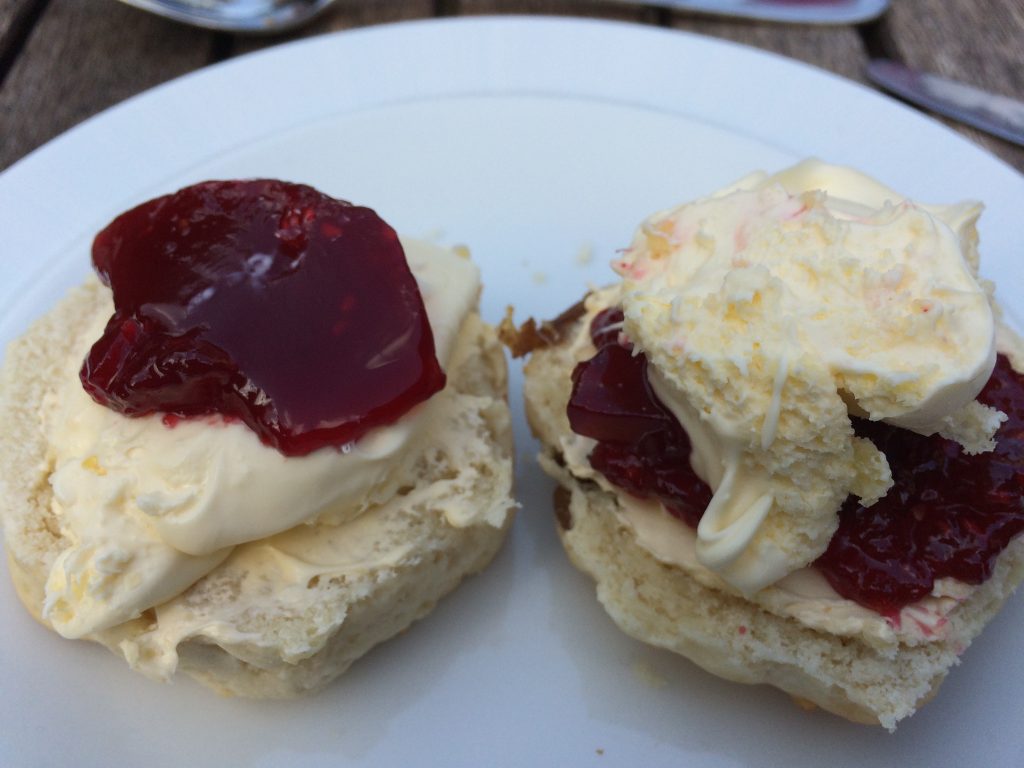
In Devon We Grow More Grass Than Fruit Or Vegetable. Cows Eat Grass & Produce Milk For Devon Clotted Cream. But Is It Cream Or Jam First on Scones?
Table of Contents
The Devon cream tea is an ancient tradition that goes back over a thousand years. In it a scone is split or cut in half, coated liberally with dense clotted cream and topped with sumptuous jam. There is sometimes gentle debate about whether it should be raspberry or strawberry cream, we purists know that strawberry is superior, but a few disagree. What is always agreed on however is that the cream must ALWAYS go first.
Why Does It Matter If Cream Or Jam Goes First On The Scone?
To ask such a question is to question the very existence of Devon traditions. It questions the reasons we were put on earth and is like questioning the existence of gravity or Startrek.
The afternoon cream tea was invented in Devon, at Tavistock Abbey in the11th century. It is as important to a Devonian as a kilt or bagpipes is to a Scotsman or baguette is to the French. In Devon the cream tea has been described as a religion, but more important!
If you have to ask the question it is likely you will understand the answer. Perhaps you would be happier on a small island away from the pinnacle of civilisation that is Devon.
However, there has been enough debate on the topic. This article is applying science to the cream on top debate and settling it once and for all time.
To close the debate I enlisted structural engineers to examine the facts and give a conclusive answer. I give you the Cream First Facts in a Report on the Unified Structural & ThermalEngineering Report. We have included the thermal aspects of jam and clotted cream utilisation as the temperature of both change the characteristics of the materials and greatly influence the Cream First debate.
Unified Structural & Thermal Engineering Report: The Optimal Clotted Cream & Jam Scone Configuration
Objective: To determine whether jam (strawberry or raspberry) should be applied above or below clotted cream on a scone, considering:
Thermal Rationale: In theory cold cream acts as a “seal” over runny jam but I’ve yet to see a Cornishman adept enough to seal runny jam!
Risk Mitigation:
Apply jam in dollops (not smeared) to reduce scone tearing. NB This is a messy way to accomplish what should be ritualistic and an accomplishment of proficient scone handlers.
Use slightly thicker cream layer (4mm) for load distribution. Only small amounts of cream are permitted as so much will slide of the jam on to the floor.
3. Critical Failure Modes & Solutions
Issue
Cause
Solution
Cream Cracking
Thermal mismatch (cold cream + warm scone).
Let cream warm 1–2 mins or better still pre-chill scone as very cold cream is preferable.
Jam Slide
Low-viscosity jam (raspberry) + gravity.
Cornish method + thicker cream cap.
Scone Sogging
Jam moisture ingress.
Butter under layer (thermal & moisture barrier). This is my chosen method, a technique that has been in my family for over 500 years.
Delamination
Poor cold adhesion.
Thin layers; press jam lightly into scone.
4. General Best Practices
Temperature Management:
Ideal: Scone at fridge temp, cream/jam chilled (only 2–5 mins out of fridge before eating).
Worst Case: Avoid hot scone + cold cream (thermal shear failure). And it tastes disgusting!
Layer Thickness:
Max 3:2 cream-to-jam ratio by height.
Strawberry: 3mm cream + 2mm jam.
Raspberry: 4mm cream + 2mm jam.
The above is for amateurs and tourists. A True Devonian uses 12 mm clotted cream adeptly positioned on the scone with a cap of succulent jam.
Construction Sequence:
Strawberry: Scone → Butter → Cream → Jam. This is the vastly superior technique, proven by generations of true Devonians going back to the 11th century
Raspberry: Scone → Butter → Jam → Cream. Proved in extensive tests to be structurally inadequate.
Raspberry Jam:Cornish Method (jam first). Cream attempts to seal jam flow, but is proven to accelerate total collapse and has been inplicated in severe cases of scone crumble.
Pro Tip: For maximum structural and thermal harmony, assemble scones immediately before serving to balance any slight temperature gradients.
Bonus: A finite-element analysis would confirm stress concentrations at the jam/cream interface, but empirical testing (i.e., eating) supports these findings. 😉
Look out for a future analysis of perceived fracture mechanics within a scone crumb propagation scenario.