Alley Crops aka Alley Cropping Or Biodiverse Cropping Is An Agroforestry Technique With Many Benefits For Farmer, Community & Environment. In this Article I Examine The Benefits & Disadvantages Of This Ancient Technique.
Table of Contents
I say ancient technique because though the term might be newish, the technique isn’t. But more on that later. Let’s start by defining Alley Cropping.
What Is Alley Cropping?
Alley Cropping is a very descriptive term. It is “what it says on the tin”. It is crops grown in rows with alleys between them. For example, the site I visited recently near me in Devon has rows of apple and elder across a 50 acre field with arable crops grown between the rows. The row spacing used in this case is quite wide, normally it is anything from 30-150 metres, more than in past times, and depends on many factors. Today it wider partly due to the use of bigger machinery and the fact that fields are quite big today. Traditionally the row spacings would have been much reduced. More on that later.
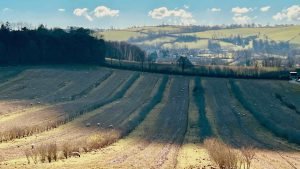
But what about the space between the rows? In the field I examined the last crop had been heritage wheat. It had been harvested and sent to a local mill and then on to a bread maker to produce bread. This meant the food miles were very low and hence so was the carbon attributed to the bread. When I visited and took the photo it was the end of February and the wheat stubble was being grazed by sheep.
As can be seen from the photo the tree rows go with the slope ie they go from the top to the bottom of the field. The slope is relatively gentle and erosion of ploughed or cultivated soil could be expected to be minimal. Should it have been steeper and the cropping had been , say, vegetables, the rows could have followed the contour and significantly reduced the erosion risk. Closer rows across the slope would further reduce erosion risk. Hence the spacings in this technique depend on the cropping and the slope and soil type. There are no hard and fast rules.
The other thing you might notice is the strip of grass down each side of the trees. This is great for wildlife and can increase profits!
How?
Simple, it is a beetle bank. Beetles and other beneficial insects breed here and then predate pests on the crops. That means a reduction in pesticide use .. in many cases a cessation of pesticides. That saves money and can increase net profit.
And of course the environmental benefits are huge. For example rodent numbers increase, barn owls love the area and other raptors also benefit. Perching posts are incorporated in the field to make it even more attractive to them!
There is no monoculture here, this is polyculture.
Below is an article I wrote on this specific project.
The Dartington Estate: Broadlears Agroforestry Research Project
In the heart of South Devon, a groundbreaking initiative is transforming the way we think about farming. The Broadlears Agroforestry Research Project, a collaboration between Dartington Trust, Luscombe Drinks, The Apricot Centre, Old Parsonage Farm, and Salthouse & Peppermongers, is pioneering regenerative agriculture …. or perhaps it’s just going back full circle to nearly forgotten techniques used in previous centuries. This approach not only enhances biodiversity and soil health but also supports local communities and promotes sustainable food systems.
What is Regenerative Agriculture?
Regenerative agriculture is a holistic farming method that works in harmony with the land. Unlike conventional farming, which often depletes soil nutrients and relies heavily on chemical inputs, regenerative agriculture focuses on improving soil life, increasing biodiversity, and creating resilient ecosystems. The Broadlears project exemplifies this by integrating apple trees and elder bushes with arable crops and grazing, creating a diverse habitat that produces food and also benefits both wildlife and soil health.
The Benefits of Agroforestry
One of the key features of the Broadlears project is its use of agroforestry, where trees and shrubs are grown alongside crops. This method offers numerous advantages:
Biodiversity: The combination of trees, shrubs, and crops creates a rich habitat for birds and insects. Birds of prey perch on strategically placed posts, helping to control rodent populations naturally.
Soil Health: The diverse plant life improves soil structure and fertility, reducing the need for chemical fertilisers. The roots of trees and shrubs help prevent soil erosion and increase water percolation and retention.
Sustainability: By producing food locally, the project reduces food miles and reliance on fossil fuels. Heritage wheat grown on the site is ground at Dartington Mill and baked into bread at the nearby Almond Thief bakery, while apples and elderflowers are sold locally or used in food and drink production.
Community Support: The project supports local businesses and communities, creating a sustainable economic model that benefits everyone involved.
Spreading Risk And Workload: By growing multiple crops the risks of crop failure is decreased. In an ideal world all the crops will thrive. But should one fail then the others can still thrive and bring in an income. It is a principle I understand from my market gardening days. We grew many different crops, so if one failed, or prices were poor, we had other crops to bring in an income. The spread of crops also spreads the workload. Though each crop may yield less than if grown alone the aggregate yield is invariably much higher with these systems.
Challenges and Considerations
While the benefits of regenerative agriculture are clear, there are also challenges to consider:
Initial Investment: Establishing an agroforestry system requires significant upfront investment in terms of time, labour, and resources. Planting trees and shrubs, and integrating them with crops, can be more complex than conventional farming methods. However grants are sometimes available and can offset costs. Farming is also a longterm business and profits over a few years are often more important than over one year, provided cash flow can be maintained.
Knowledge and Expertise: Successful implementation of regenerative agriculture requires a deep understanding of ecological principles and sustainable farming practices. Farmers may need training and support to transition to this method.
Long-Term Commitment: The benefits of regenerative agriculture, such as improved soil health and biodiversity, often take time to manifest. Farmers need to be patient and committed to seeing the long-term rewards.
True Polyculture
Cropping on this land consists of wheat, apples and elders (potentially flowers and berries) plus grazing.
A Model for the Future
The Broadlears Agroforestry Research Project is more than just a farming initiative; it’s a model for a sustainable future. By demonstrating the potential of regenerative agriculture, the project shows how we can produce food in a way that benefits the environment, supports local communities, and creates a more resilient food system.
As we face the challenges of climate change and environmental degradation, projects like Broadlears offer hope and a path forward. By supporting such initiatives, we contribute to a healthier planet and a more positive future for generations to come.
By embracing regenerative agriculture, the Broadlears project is not only improving the land but is also inspiring others to rethink how we grow our food. It’s a testament to the power of collaboration and innovation in creating a sustainable and equitable world.
A final thought about Broadlears .. I’d argue that this isn’t an experiment to see if this works. We know it can work, we farmed this way for many centuries. What this project is about is relearning the techniques we have forgotten. Accepted we now have massive farm machinery and don’t use ox ploughs, but the principles are the same. And it should be easier for us as we better understand the science.
To explain this better I have added a video that mentions the above project. Seeing is believing … see what you think.
Is Alley Cropping A Form of Agroforestry Or Silviculture?
Agroforestry is defined as a land management system that combines agriculture and “forestry”. It involves growing trees and crops together, and can also include orchard trees, shrubs and pasture.
Silviculture is the care and cultivation of woodlands.
So, yes to agroforestry, if we are happy to include orchards and/or fruit trees in the forestry definition, but no to silviculture.
Of course we could have mixed silviculture. Rows or blocks of assorted trees in a single area. Mixing perhaps fruit production with timber production. If so this could be viewed as alley cropping!
Arguably it doesn’t matter too much. This is a way of being biointensive on farmland. Where several crops are grown in the same field art the same time.
Alley Cropping History
Alley cropping is considered an ancient agroforestry technique, though the modern term was coined more recently. Traditional farming communities around the world have long practiced similar methods, integrating trees or shrubs with crops to enhance soil fertility, prevent erosion, and improve yields.
For example:
Indigenous African and Asian agroforestry systems have incorporated trees like Acacia, Faidherbia, and Gliricidia for centuries to improve soil nutrients and protect crops.
The Mayans and other pre-Columbian civilizations used intercropping methods that included tree species for shade, nitrogen fixation, and wind protection.
Traditional European silvo-arable systems often included hedgerows and orchards alongside crops, resembling modern alley cropping.
Orchard based alley cropping systems. This is one I have first hand knowledge of as my grandfather practiced it and I recall it very well. Elsewhere I have argued it was a food forest and so it was. The question to pose might be when does a food forest become alley cropping? The problem as I see it is that humans try to categorise everything. The reality is all these systems overlap. My grandfather grew apples and other fruit trees in rows with other plants grown between them There were flowers for cutting, grass for grazing sheep and for pigs to root through when we had windblown apples. It was an integrated system of trees and mixed farming. Was it a food forest or alley cropping? It was both or neither …. it just depends which pigeonhole you want to put it in.
My Alley Cropping Conclusions
While the structured, research-based approach to alley cropping is very much about today’s regenerative farming ideas, the core concept has deep historical roots and, I believe, will form the basis of future farming.
Agroforestry & Alley Cropping: The Video
The section on Dartington starts at 3.55 … but the rest is also worth watching.
Fascinating and interesting account of Alley Cropping on such a large scale Stefan. When I lived at Whimple the cider orchards had sheep grazing underneath them, moving the sheep from orchard to orchard. Often, there were permanent colonies of honey bees as well, so 3 crops in total producing an income at different times. At Feniton, there was a farm that did the same but with dessert apples, permanent sheds of free range hens for eggs and permanent colonies of honeybees.
A thought on “Regenerative Farming” which I think is as important to pursue as Climate Change and far less questionable as a way for the future. Many farmers struggle to made a good income and depend on government grants. If all the currents grants were discontinued and switched to grants for regenerative farming based on sampling soil surface structure, along with all the current government agencies monitoring systems, then farmers would be more inclined to follow that route.
My grandfather used to grow apples for Whimple. He had 5 acres north of Pinhole, right next to the Brick quarry. This land was “pure” clay and it went down hundreds of feet as could be seen by the depth of the quarry.
Grandad had what I believe was a food forest. He kept pigs and chicken under the trees (apples, pears. plums etc). Each tree had daffodils around the base and these were harvested as cut flowers. In the hedges grew hazel, crab apples, hops and dozen of other edibles. In the spring, when the grass starts growing, sheep were brought in for a few weeks to a time.
The currency of the day was barter. An apple basket of Blenheim’s or Worcester’s for tea, cheese, bread etc. A dozen bunches of daffs for flour etc.
It is often said that food forests are new. Grandad would have laughed at the idea. His father and grandfather had always farmed this way.

Fascinating and interesting account of Alley Cropping on such a large scale Stefan. When I lived at Whimple the cider orchards had sheep grazing underneath them, moving the sheep from orchard to orchard. Often, there were permanent colonies of honey bees as well, so 3 crops in total producing an income at different times. At Feniton, there was a farm that did the same but with dessert apples, permanent sheds of free range hens for eggs and permanent colonies of honeybees.
A thought on “Regenerative Farming” which I think is as important to pursue as Climate Change and far less questionable as a way for the future. Many farmers struggle to made a good income and depend on government grants. If all the currents grants were discontinued and switched to grants for regenerative farming based on sampling soil surface structure, along with all the current government agencies monitoring systems, then farmers would be more inclined to follow that route.
Thanks Mick
My grandfather used to grow apples for Whimple. He had 5 acres north of Pinhole, right next to the Brick quarry. This land was “pure” clay and it went down hundreds of feet as could be seen by the depth of the quarry.
Grandad had what I believe was a food forest. He kept pigs and chicken under the trees (apples, pears. plums etc). Each tree had daffodils around the base and these were harvested as cut flowers. In the hedges grew hazel, crab apples, hops and dozen of other edibles. In the spring, when the grass starts growing, sheep were brought in for a few weeks to a time.
The currency of the day was barter. An apple basket of Blenheim’s or Worcester’s for tea, cheese, bread etc. A dozen bunches of daffs for flour etc.
It is often said that food forests are new. Grandad would have laughed at the idea. His father and grandfather had always farmed this way.