To Effectively Harvest Rainwater In UK Gardens And Allotments, We Need To Focus On Maximising Collection From All Available Surfaces And Directing It To Storage, Even When Direct Tank Placement Isn’t Feasible. This Approach Ensures A Reliable, Sustainable Supply Of Water, Crucial Given The Often-Unpredictable British Weather & Increasing Summer Droughts.
Table of Contents
The Power of Rainwater Diverters
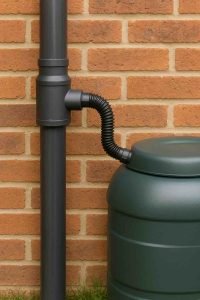
A key element in a comprehensive rainwater harvesting system is the installation of rainwater diverters on every downpipe. This should be done irrespective of whether a water butt or tank can be placed directly underneath as tanks can be at a distance and water piped to them . The primary function of a diverter is to channel rainwater from a building’s guttering into a container. By fitting these devices to every downpipe on a house, shed, garage, or greenhouse, you can capture water that would otherwise be lost to drains.
Piping around the garden can be done inexpensively via hosepipes, which can be buried in shallow trenches if required. I bury mine just an inch deep. I don’t worry about them freezing as they will not split and there is no water flow when we have freezing conditions!
Hence the water collected by these dispersed diverters can then be connected via a simple network of pipes. This allows the water to be channelled from multiple buildings to a single, larger storage tank located in a more convenient or remote part of the garden or allotment. This centralisation of storage provides a much greater capacity than multiple small butts and makes the water easier to access for watering. Though there is an argument for using multiple smaller tanks to give flexibility.
Maximising Water Flow and Volumes – How To Harvest More Rainwater Effectively
Consider the principle of gravity and the fact that water finds its own level. For gardens and allotments with uneven terrain, this can be exploited to your advantage. A rainwater diverter does not need to be positioned level with an adjacent water butt. If you have a tank situated at a higher point in the garden, perhaps on a raised platform or at the top of a slope, the diverter can be installed higher up the downpipe to feed it. This can make it level with the distant storage tank and utilises the fact that water finds its own level! This is particularly useful in hilly or terraced gardens, where a high-level tank can then provide a gravity pressurised supply for watering, without the need for a pump, simply by gravity feed.
Interconnected Tanks & Other Rainwater Collection Mistakes
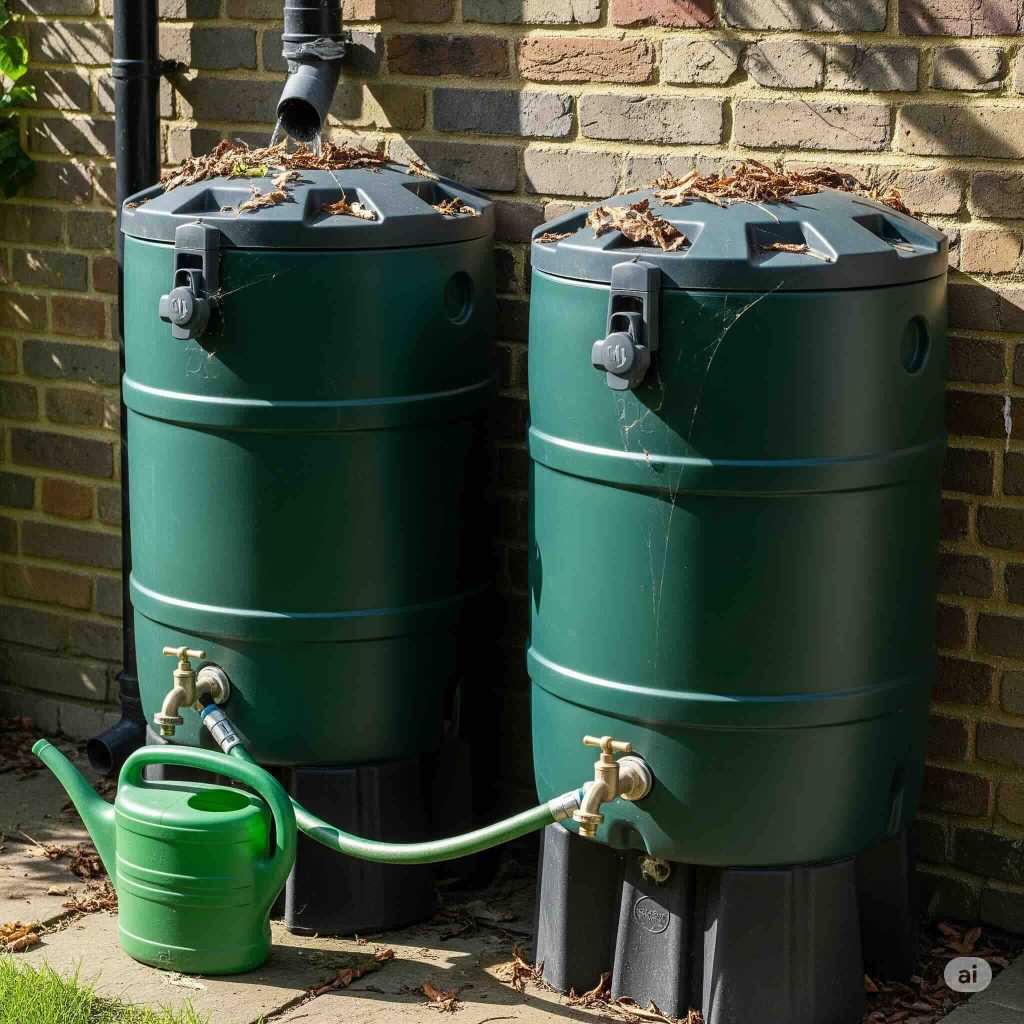
It often makes perfect sense to link several water butts together. This increases storage volume without the hassle of moving pipes from one butt to another. But there is a potential problem with this should a tank, its tap or pipework get damaged. There is a potential to lose the water from ALL the tanks at once.
This is a problem where interconnected tanks are linked by a low level pipework. One hole and we see water finding its own level!
The solution is very simple. Only connect them at high level. Then if one springs a leak it will not drain all the others. Filling is easy. The first butt fills and overflows into the second. That then fills and overflows into the third. and so it goes on. And if you have two downpipes filling the same group of interconnected tanks ensure that each indeed goes to a different tank in the group. It is simple and logical but so often we get it wrong!
Getting the water diverter at the right level is essential or it will either not fill the butt .. water doesn’t run uphill OR it will fill the butt and overflow. In some cases the latter is designed into the system so that the overflowing water can be piped to other tanks, into a swale or even a stream.
Some of the images in the following section are AI produced because I couldn’t find examples of incorrectly designed or installed systems. I’m quite pleased that this is the case.
Gallery images …
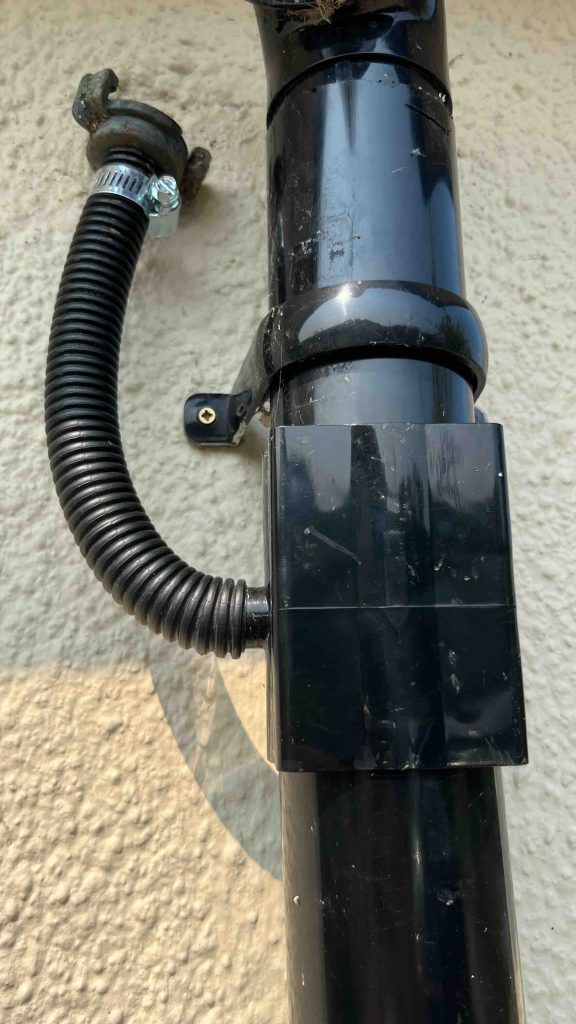
The first gallery image (below) is of a high level rainwater diverter with a geka coupling. The pipework is pointing upwards which acts like a tap and stops the flow. Swivel it downwards and flow will commence … but remember to connect a hosepipe to take the weave rot the tank!
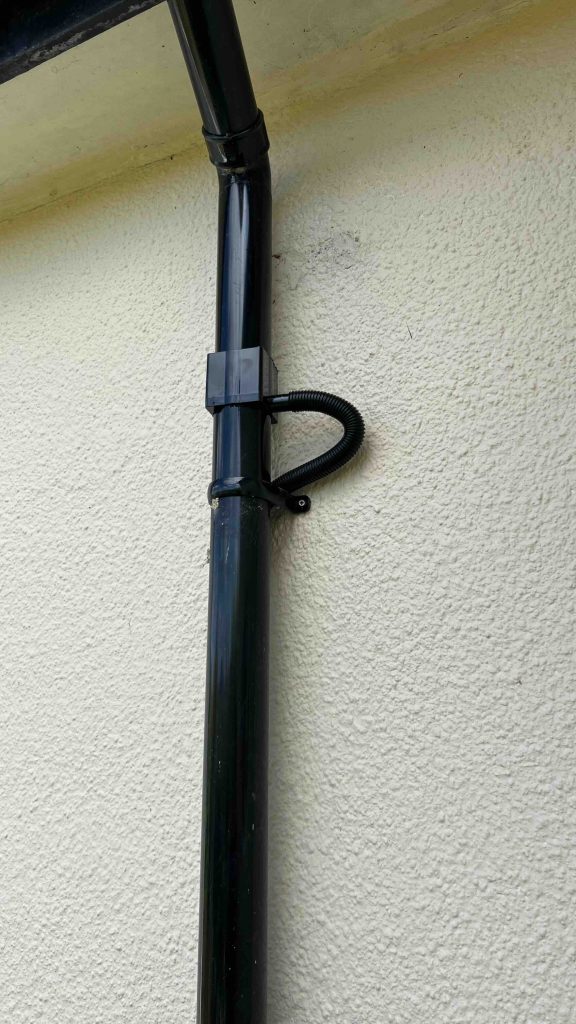
The second image shows how unsightly hoses can be hidden behind downpipes. This particular diverter is at a high level. But so is the distant IBC tank it fills. It is at quite a distance and out of sight. But the levels are spot on and were determined by using water in a hosepipe to find the precise levels! Think it through and the method hopefully becomes clear.
Image three is AI produced as I couldn’t find a convenient badly connected example. These butts are connected with allow level pipe. If either tank, the taps or the pipework leaks the whole lot is going to eventually empty.
The volume of water that can be collected is directly proportional to the roof’s surface area and the amount of rainfall. A simple metric to remember is that one millimetre of rain on one square metre of roof surface yields approximately one litre of water. For example, a typical garage roof of 20m2 would collect 20L of water from just 1mm of rainfall. This can be substantial over the course of a year. The average annual rainfall in the UK varies by region but is around 1,100mm. A 50m2 roof would theoretically collect 55,000 litres annually, far exceeding the needs of most small gardens.
I say theoretically because we rarely see a system that can collect a full seasons rainwater at once. I explain the solution in the following section.
Maximising Summer Replenishment
While the UK sees a high annual rainfall, it is often not evenly distributed. A significant challenge for gardeners is the peak demand for water during the drier summer months when rainfall is less frequent. Therefore, maximising rainwater collection during summer showers is critical for maintaining a usable supply.
To achieve this, ensure all diverters and storage systems are clear and ready to capture any rainfall. Regularly check guttering for blockages from leaves and debris. Keep storage tanks and butts clean to prevent sediment build-up which can reduce capacity. By being proactive and prepared, you can capitalise on every summer shower, even small ones, to top up your reserves. The aim is to ensure the system is at maximum capacity before a dry spell, providing a crucial buffer when plants need it most. This holistic method of capturing and storing rainwater from every available surface ensures that you maximise your water savings, reduce your reliance on the mains supply, and create a resilient system for keeping your plants hydrated.