English Walled Gardens Are Renowned For Their Unique Blend Of Functionality, Beauty, And Historical Significance. Here Are Their Key Features With Examples.
Table of Contents
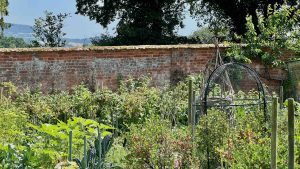
Walled gardens have been around for centuries. Their precursor would have been enclosed gardens, perhaps just surrounded by hedges. But the brick or stone wall type of garden dated back to at least 1621 if judged by those still in existence.
Oxford Botanic Garden’s Walled Garden: Dates back to the garden’s foundation in 1621.
Blenheim Palace’s Walled Garden: The first garden feature completed in 1707 and is now its oldest surviving feature.
Castle Howard’s Walled Garden: First recorded in 1703, with construction of the gardener’s house and kitchen garden.
If we go back to medieval times there is further evidence. The concept of the “hortus conclusus” (enclosed garden) was central to monastic life. Cloisters, surrounded by the monastery buildings, served as enclosed gardens for contemplation, growing medicinal herbs, and food. These were effectively walled gardens, though their primary purpose and form differed from later kitchen gardens. While many monastic sites are now ruins, their layout clearly indicates these enclosed spaces.
The most famous abbey that still has signs of its original walled garden is Westminster Abbey.
While much of the monastic precinct has been built over or altered, the Little Cloister Garden (part of the infirmary complex) is still a tranquil enclosed space, and the general layout of the main cloister (though now a grass “garth”) reflects its original enclosed nature. Records of the monastic gardens, including the “gardens where the monks took exercise and grew herbs,” attest to their presence and function.
Of course the walled garden wasn’t limited to England. There are prime examples in Scotland, Wales And Ireland. But we have to remember that these are private gardens, not community gardens, and were there to feed their owners.
Walled Garden Attributes
Shelter and Microclimate Creation
Walled gardens are enclosed by high brick or stone walls, which serve multiple purposes:
Wind Protection: The walls shield plants from harsh winds, allowing delicate species to thrive .
Heat Retention: Brick and stone absorb solar heat during the day and release it slowly, raising the ambient temperature by several degrees. This creates a microclimate ideal for growing plants, that would otherwise struggle in cooler climates, such as peaches, nectarines, and grapes .
Frost Mitigation: Frost doors or gates (often placed at the lowest point of the garden) allow cold air to drain away, preventing frost damage to tender plants .
Growing Exotic and Tender Plants
The warm microclimate enables the cultivation of “exotic” species:
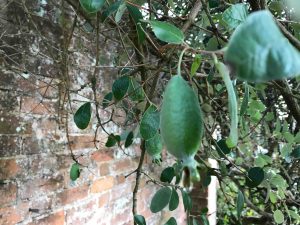
Espaliered Fruit Trees: Apples, pears, and figs are trained against south-facing walls to maximize sun exposure .
Glasshouses and Orangeries: Many walled gardens include heated structures (like peach houses or vineries) to grow citrus, pineapples, and other tropical plants .
Historical Collections: For example, Hampton Court’s Lower Orangery housed rare plants like agaves, orchids, and coffee trees in the 17th century .
Functional Layout and Design
Quadrant System: Traditional Persian-inspired layouts divide the garden into four quarters with central pathways, often featuring a pool or wellhead .
Symmetry and Order: Beds are arranged geometrically, with paths lined by hedges or flowers for visual appeal .
Multi-Purpose Zones: Some gardens combine productivity with leisure, integrating vegetable plots with ornamental features like pergolas or rose-covered arches .
Historical and Social Role
Kitchen Gardens: Large estates used walled gardens to grow food year-round, with 1 acre feeding 12 people. Queen Victoria’s Windsor garden spanned 31 acres .
Status Symbols: Elaborate glasshouses and exotic plants (like pineapples) displayed wealth .
Post-War Decline: Many fell into disuse after WWI but are now revived as vineyards (e.g., Highclere Castle) or tourist attractions .
Special Structures and Innovations
Heated Walls: Hollow walls with internal fires or pipes provided extra warmth (e.g., Croxteth Hall) .
Frost Gates: Positioned to let cold air escape, protecting blossoms in orchards .
Companion Planting: Herbs and flowers (e.g., lavender, sweet peas) were grown alongside vegetables to deter pests .
Examples of Notable Walled Gardens
Chicago Botanic Garden’s English Walled Garden: Features six themed “rooms” with sensory plantings .
Highclere Castle: Converted a historic kitchen garden into a vineyard .
Holkham Hall: Includes an 18th-century vinery with rare citrus varieties .
For further inspiration, visit restored gardens like Floors Castle (Scotland) or Chartwell (Kent), where Winston Churchill laid bricks himself .